Hull ID Verification Made Simple: Free Boat HIN Lookup Tool
That 12-character code stamped on the transom isn’t just a serial number—it’s the key to uncovering whether a boat has been stolen, totaled, or saddled with hidden liens. We call this a boat hin lookup. Skipping hull ID verification before purchase is how buyers end up losing thousands on vessels they can’t legally own.
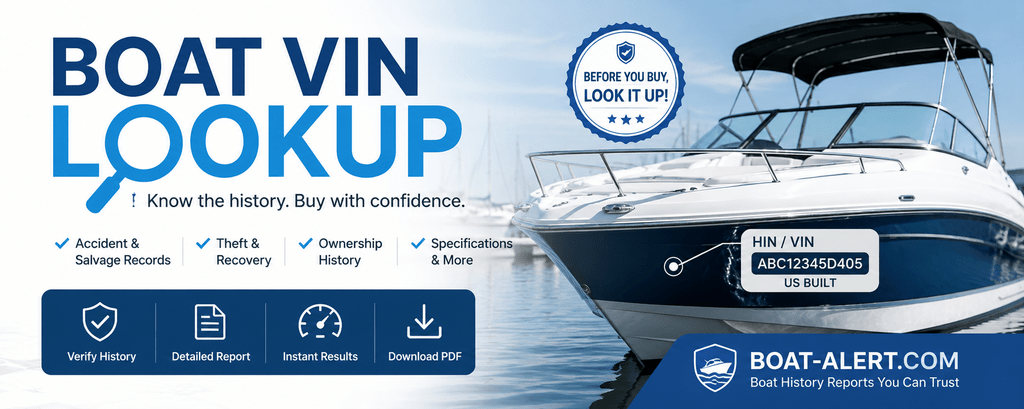
This guide walks you through where to find the HIN, how to decode each character, what free tools can and can’t reveal, and the red flags that signal a tampered or cloned hull number.
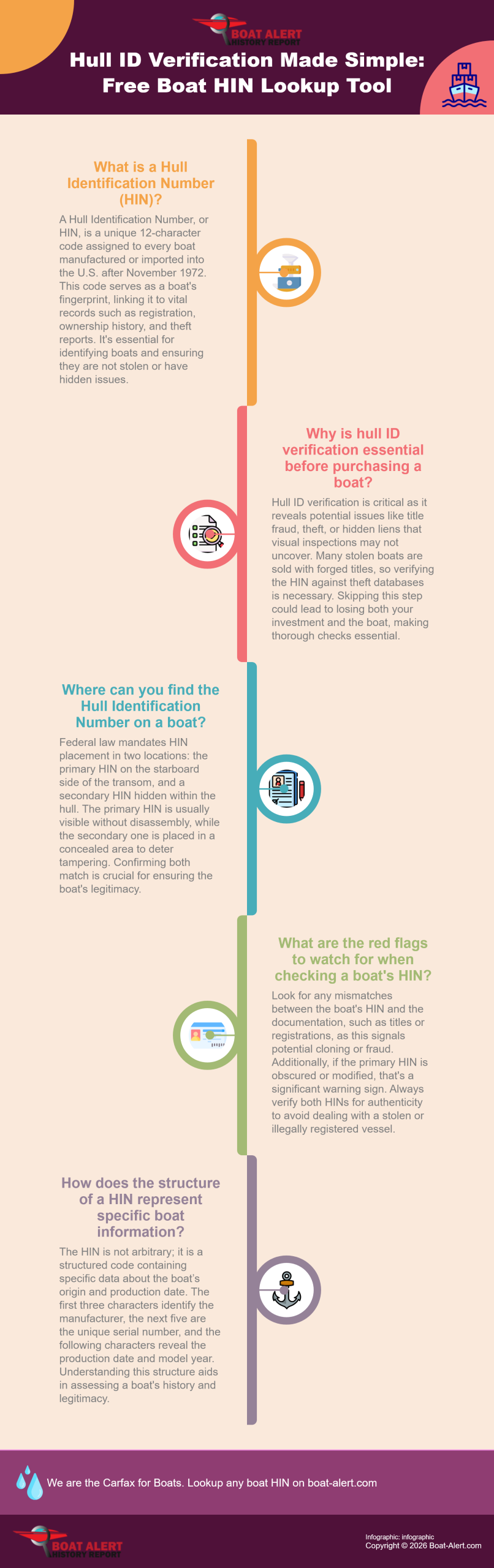
What is a hull identification number
A Hull Identification Number (HIN) is a 12-character code permanently attached to every boat built or imported into the United States after November 1972. It works like a boat’s fingerprint—no two vessels share the same number, and it connects the boat to its entire paper trail: registration records, ownership history, theft reports, and insurance claims.
You’ll often hear people call it a “boat VIN,” which makes sense since it serves the same purpose as a car’s Vehicle Identification Number. The official term used by the U.S. Coast Guard and state agencies, though, is HIN. When searching databases or filling out registration forms, stick with “HIN” for more accurate results.
Why hull ID verification matters before you buy a boat | hull id lookup
A sea trial tells you how the engine runs. A pre-purchase boat survey reveals hull condition. Neither one, however, will surface title fraud, stolen vessels, or hidden liens. Those problems live in databases, not in the bilge.
Stolen boats and title fraud
Over 4,400 boats were stolen in the U.S. in a single year, and Stolen boats don’t always look suspicious. Criminals resell them with forged titles, sometimes moving them across state lines where the theft hasn’t been reported locally. If you buy a stolen vessel, you lose both the boat and your money when authorities recover it.
A hull ID verification checks the HIN against theft databases, including records that local searches won’t catch. Free tools can’t access most of these records, but a comprehensive boat history report can flag stolen vessels before you hand over cash.
Hidden salvage and total loss history
Insurance companies issue salvage titles when repair costs exceed a boat’s value—typically after hurricanes, fires, or major collisions. Some sellers repair these boats cosmetically and resell them without saying a word about the damage.
Structural problems from flooding or impact often cause long-term issues that aren’t visible during a walkthrough. A boat with hidden salvage history may be uninsurable, difficult to resell, and potentially unsafe on the water.
Paperwork that does not match the boat
HIN cloning is a scheme where criminals take a legitimate HIN from one boat and stamp it onto a stolen vessel. The paperwork looks clean because it belongs to a real, legal boat—just not the one sitting in front of you.
Always physically verify the HIN on the hull and compare it character-by-character to the title and registration. Any mismatch between documents and the actual boat is a serious red flag.
Where to find the HIN on your boat
Federal law requires manufacturers to attach the HIN in two separate locations. Finding both and confirming they match takes only a few minutes and catches basic fraud attempts.
Primary HIN location on the transom
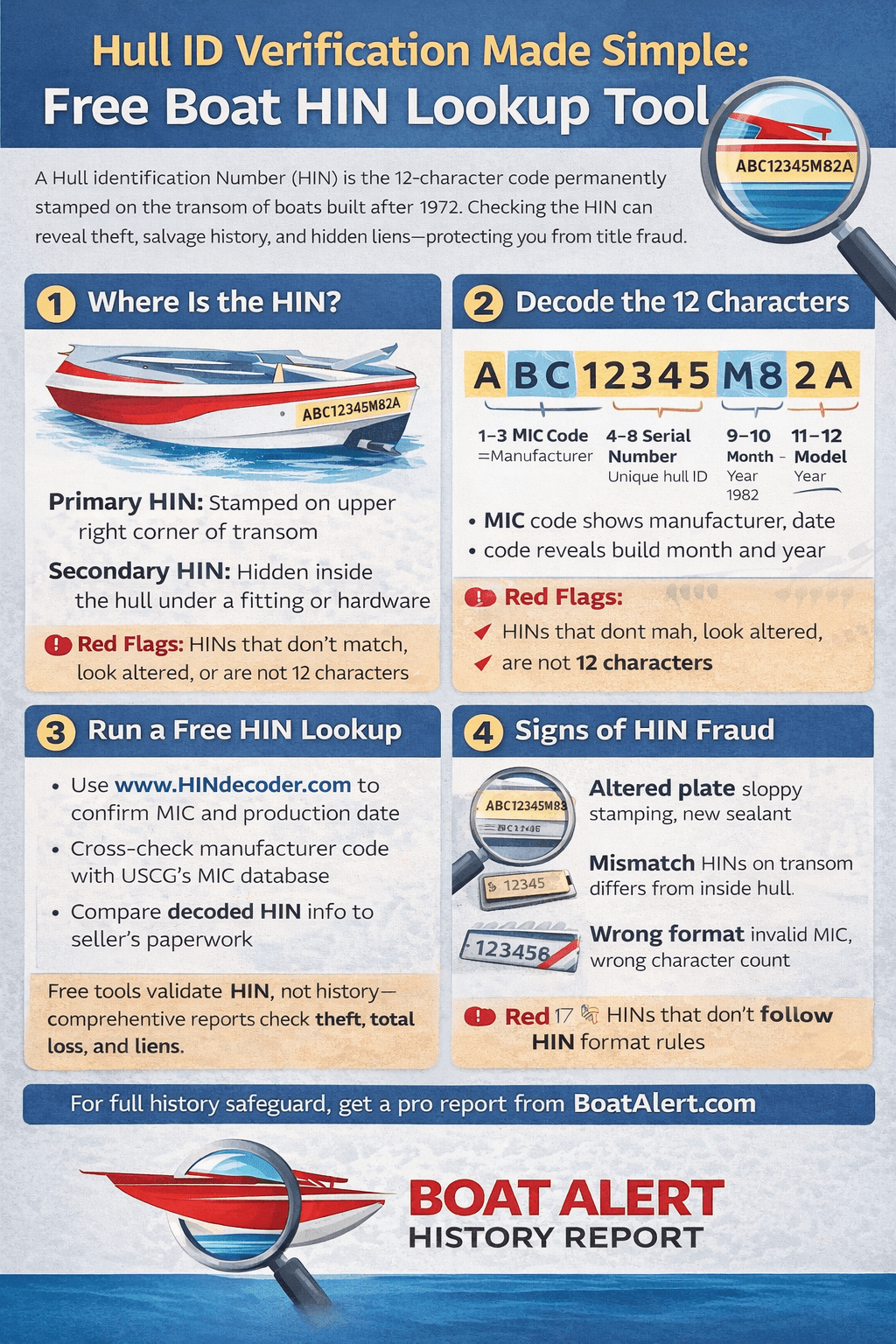
The primary HIN appears on the starboard (right) side of the transom, typically within two inches of the top. It’s either stamped into a metal plate, engraved directly into the hull, or molded into fiberglass.
You shouldn’t have to remove any hardware to see it. If the primary HIN is obscured, painted over, or requires disassembly to access, treat that as a warning sign.
Secondary HIN location inside the hull
The secondary (or “hidden”) HIN sits in an unexposed location—under a fitting, inside the hull, or beneath hardware. Manufacturers choose spots that would be difficult to alter without leaving obvious evidence.
This redundancy exists specifically to catch tampering. If someone removes or alters the visible transom HIN, the hidden one provides a backup for identification.
Jet ski and personal watercraft HIN placement
Jet skis and PWC follow the same 12-character HIN format, though placement varies by brand. Common locations include the stern, inside the engine compartment, or under the seat. Yamaha, Sea-Doo, and Kawasaki each have preferred spots, so checking the owner’s manual or a jet ski pre-purchase inspection checklist saves time.
What each character in a hull ID number means
The HIN isn’t random—it’s a structured code that reveals specific information about the boat’s origin and manufacture date.
| Position | Characters | What It Reveals |
|---|---|---|
| 1–3 | MIC Code | Manufacturer identity |
| 4–8 | Serial Number | Unique hull identifier |
| 9–10 | Date Code | Month and year of production |
| 11–12 | Model Year | Certified model year |
Manufacturer identification code
The first three characters form the Manufacturer Identification Code (MIC), assigned by the U.S. Coast Guard to each registered boat builder. You can verify any MIC against the official USCG database to confirm the manufacturer exists.
An unrecognized MIC—or one that doesn’t match the brand name on the boat—signals a potential problem.
Hull serial number
Characters 4 through 8 are the manufacturer’s unique serial number for that specific hull. These can include letters and numbers, assigned by the builder’s internal system.
Month and year of manufacture
Characters 9 and 10 indicate when the boat was physically built. This production date sometimes differs from the model year, especially for boats manufactured late in a calendar year.
Model year designator
The final two characters represent the certified model year. Comparing this to the seller’s claims and the decoded production date helps verify consistency across all documentation.
How to verify a hull ID number for free
Before investing in a paid history report, you can perform several basic verification steps at no cost. These checks confirm the HIN format is valid and the manufacturer is legitimate—though they won’t reveal theft, salvage, or lien history.
1. Locate and record the full 12-character HIN
Find both HIN locations on the boat and write down each character carefully. One wrong letter or digit invalidates any database search. Compare the primary and secondary HINs to confirm they match exactly.
2. Use a free online HIN decoder tool
Free decoder tools like HINDecoder.com parse the 12 characters to display the manufacturer name, production date, and model year. This confirms the format follows Coast Guard standards but doesn’t search any history databases.
3. Cross-check the manufacturer code with the USCG database
Visit the U.S. Coast Guard’s official MIC lookup to verify the three-letter manufacturer code corresponds to a registered boat builder. An invalid or unrecognized MIC is an immediate red flag.
4. Compare decoded results to the seller paperwork
Match the decoded information—manufacturer, build date, model year—against the title, registration, and seller’s verbal claims. Any discrepancy warrants further investigation.
What a free hull identification number lookup cannot tell you
Free decoders validate format and identify the manufacturer, but they don’t search the databases that matter most for buyer protection.
Theft records from NCIC and international databases
The FBI’s National Crime Information Center (NCIC) maintains the primary U.S. stolen property database, and it’s not publicly accessible. Records without a hull serial number are purged after 90 days, making a valid HIN critical for theft recovery. Free tools simply can’t check whether a boat has been reported stolen.
Salvage and total loss history from insurance companies
When insurers total a boat, they report it to private databases that aggregate claims data. This information doesn’t appear in free lookups. A boat can look pristine while hiding a salvage history that affects safety and resale value.
Liens and title brands from NMVTIS
The National Motor Vehicle Title Information System (NMVTIS) is the federal database for title records, including some boat data. Accessing it requires paid services. Free tools won’t reveal outstanding liens or title brands like “salvage” or “flood damage.”
Accident history and insurance claims
Prior accidents, damage claims, and repair history are held by insurance companies and aren’t publicly searchable. Free verification can’t tell you if the boat was previously wrecked and repaired.
How to spot a tampered or cloned HIN plate
Physical inspection of the HIN plate itself can reveal fraud that database searches might miss.
Signs of physical alteration on the HIN plate
Look closely for warning indicators:
- Misaligned characters: uneven spacing or crooked letters
- Inconsistent fonts: characters that don’t match in style or stamping depth
- Tool marks: evidence of grinding, filing, or re-stamping
- Fresh sealant: suggests recent removal and reattachment
- Paint overspray: covering original markings or plate edges
Mismatched primary and secondary HINs
Both HIN locations on a boat display identical numbers. If they differ—even by one character—the boat may have a replaced transom or be a cloned vessel. Don’t accept explanations like “the previous owner replaced the transom” without extensive documentation.
Characters that do not follow standard HIN format
Format violations that indicate a fake or altered HIN include wrong character count (it’s always exactly 12), an invalid MIC code, use of prohibited letters O, Q, or I, and illogical date codes.
How to verify boats built before 1972
The standardized HIN system began in November 1972, so older boats may have non-standard serial numbers—or none at all.
Check state registration records, which may have assigned a state-issued HIN when the boat was first registered after 1972. The U.S. Coast Guard Documentation database covers federally documented vessels regardless of age. History reports have limited data for pre-1972 vessels simply because standardized tracking didn’t exist then.
What to do if your hull ID verification fails
When something doesn’t check out—mismatched numbers, suspicious alterations, or database flags—take protective action rather than hoping the problem resolves itself.
1. Request additional documentation from the seller
Ask for the original title, complete registration history, and previous survey reports. A legitimate seller with nothing to hide can typically provide paperwork. Reluctance or excuses are themselves warning signs.
2. Contact your state boating agency
State agencies maintain registration records and can verify whether the HIN matches their files. They can also check if the vessel has been reported stolen within their jurisdiction.
3. Run a comprehensive boat history report
A paid boat history report searches databases that free tools cannot access—theft records, salvage history, liens, and insurance claims. Run a professional boat history report before money changes hands. A report that searches 90+ databases costs far less than the potential loss on a problematic boat.
Protect yourself with a complete boat HIN lookup
Hull ID verification is essential, but free tools have real limits. Registered and documented boats account for only three-quarters of the total fleet, and even within that pool, free tools confirm format validity and manufacturer identity—nothing more. The information that actually protects you (theft records, salvage history, liens, title brands) lives in databases that require paid access.
A professional boat history report bridges this gap by aggregating data from state registrations, federal records, insurance companies, auction houses, and theft databases into a single searchable report. It’s not a replacement for a physical survey or sea trial, but it closes blind spots that inspection alone cannot address.
Frequently asked questions about hull ID verification
What are the requirements for a hull identification number?
All boats manufactured or imported into the U.S. after November 1972 require a 12-character HIN permanently attached in two locations—one visible on the starboard transom and one hidden inside the hull.
Can I look up a boat by registration number instead of HIN?
Yes, some boat history services offer reverse lookups using the state registration number to find the associated HIN. Results depend on state privacy laws and database availability.
How do I verify a Canadian boat HIN in the United States?
Canadian boats follow a similar HIN format, and several U.S.-based boat history report services include Canadian federal registration and provincial licensing databases in their searches.
Is a boat VIN the same as a hull identification number?
Yes, “boat VIN” is an informal term that refers to the HIN. The official designation under U.S. Coast Guard regulations is Hull Identification Number.
What happens if my boat does not have a HIN?
Contact your state boating agency to apply for a state-assigned HIN, which is required for registration. This applies to boats built before 1972, homemade vessels, and boats with missing or illegible original numbers.
#Boat #HIN #verification
If you are looking to purchase a used boat, it is essential to perform a boat hull number lookup before making any decisions. By using a boat VIN lookup or a boat hull ID lookup, you can access crucial information about the watercraft’s history. Conducting a hull identification number search can help you uncover any past accidents, title issues, or maintenance problems that may be present.
One convenient option for obtaining a boat’s history is to use a free boat serial number lookup tool. This boat HIN decoder can provide you with detailed information about the vessel, including its manufacturing date, model, and ownership history. By performing a boat HIN number lookup, you can ensure that you are making a well-informed purchase decision.
By conducting a boat lookup by hull number in English, you can easily access the information you need to make a smart investment. Whether you are looking for a family pleasure craft or a fishing boat, a thorough hull number lookup can help you avoid potential headaches down the line. Don’t skip this crucial step in the buying process – make sure to research the boat’s history by hull number before finalizing your purchase.
Categories: To learn more about Boat-Alert.com History Reports for used boats and boat hin check free visit: www.Boat-Alert.com