Taxes on Boats in Wisconsin
Boating in Wisconsin comes with a bundle of tax and fee obligations — registration fees, state sales tax, sometimes county and city tax, and a set of exemptions that are easy to misread. This guide walks through what actually applies, sourced from the Wisconsin DNR and the Wisconsin Department of Revenue (DOR).
Key Takeaways
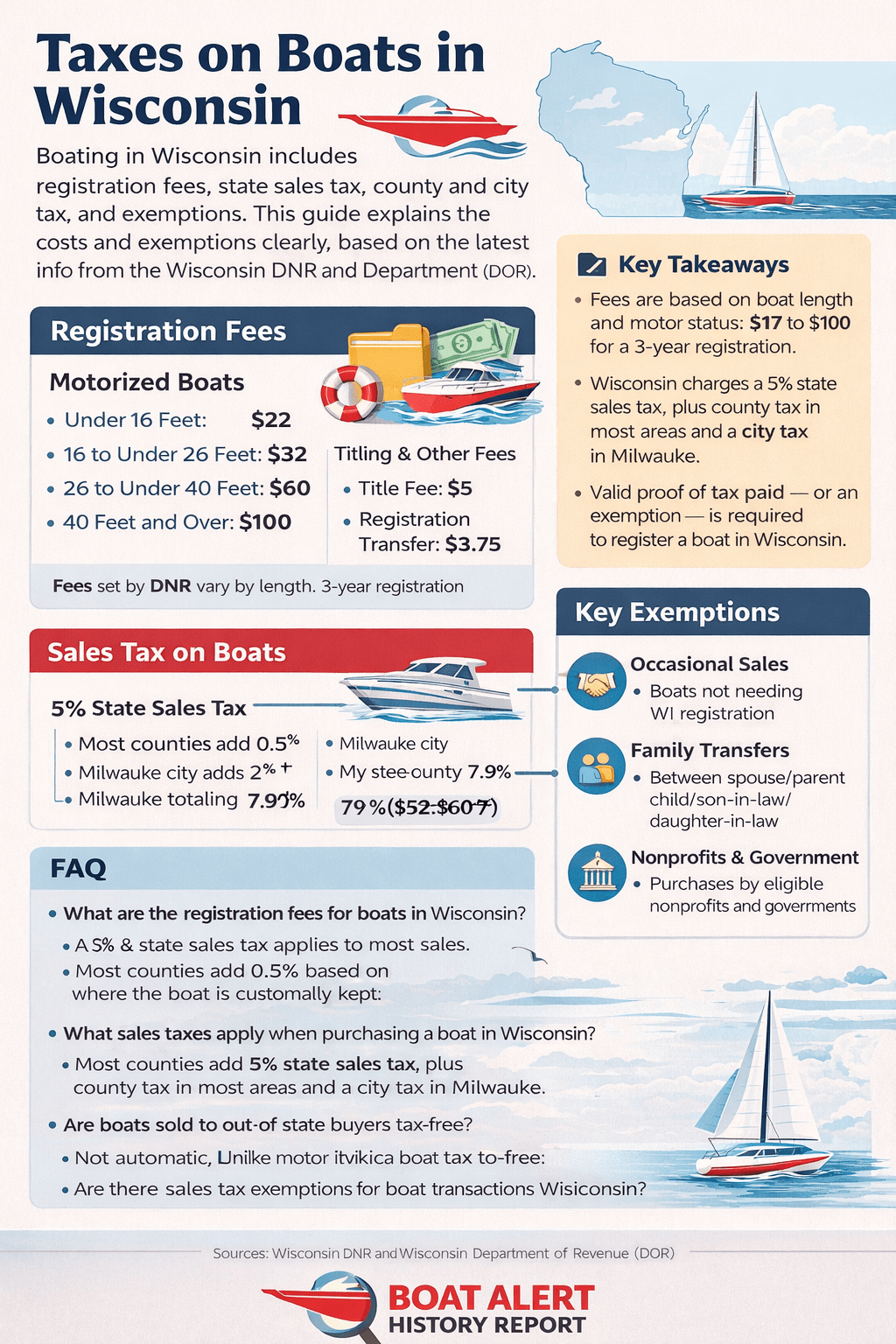
- Registration fees are based on boat length and motor status, ranging from $17 to $100 for a 3-year registration.
- Wisconsin charges a 5% state sales tax on boat sales, plus county tax (most counties) and, in Milwaukee, a city tax.
- Exemptions exist for certain family transfers, nonprofit and government purchases, and a few narrower categories — but several of the most commonly cited exemptions (occasional sales, nonresident sales, commercial fishing) are more limited than they first appear.
- You must show proof of tax paid — or a valid exemption — to register a boat in Wisconsin, even if you plan to use the boat mostly out of state.
- If you already paid sales tax to another state, Wisconsin generally credits it against what you owe here.
Boat Registration Fees
Registration fees are set by the Wisconsin DNR and are based on the boat’s length and whether it’s motorized. Registration runs for 3 years, expiring March 31 of the third year, and fees are not prorated.
Motorized boats:
- Under 16 feet: $22
- 16 feet to under 26 feet: $32
- 26 feet to under 40 feet: $60
- 40 feet and over: $100
Non-motorized sailboats: a flat $17, regardless of length.
Titling and other fees (in addition to registration):
- Title issuance or replacement: $5
- Lien filing: $5
- Registration transfer: $3.75
- Replacement registration certificate or decals: $2.50 each
Boats 16 feet and longer must be titled with the DNR; boats under 16 feet are exempt from the titling requirement (though they still need to be registered, unless otherwise exempt).
Sales Tax on Boat Purchases
Wisconsin applies a 5% state sales tax to nonexempt boat sales — new or used, private-party or dealer.
County sales tax: Most Wisconsin counties have adopted a county sales tax, generally 0.5%. It’s charged based on where the boat is customarily kept in Wisconsin, not where it was bought.
City sales tax: Currently, only the City of Milwaukee imposes one — a 2% city sales and use tax effective January 1, 2024. Milwaukee County’s own tax also rose from 0.5% to 0.9% on that date, so a boat customarily kept in Milwaukee can face a combined rate close to 7.9% (5% state + 0.9% county + 2% city). No other Wisconsin city currently levies its own boat sales tax.
Who Qualifies as a Retailer?
A “retailer” here is anyone who holds a Wisconsin seller’s permit or use tax registration and sells boats — not just licensed boat dealers. A hardware store owner who happens to sell a used boat as part of their business, for example, would still need to collect tax on that sale.
Retailer responsibilities: Registered retailers must collect and remit the correct state, county, and city tax on boat sales, provide the buyer a receipt showing the tax collected, and report it on their DOR return. If an individual sells a boat purely for personal use (not as part of a business), they aren’t required to collect tax themselves — instead, the buyer pays the applicable tax directly to the DNR when registering the boat.
When Do County and City Taxes Apply?
For boats (and motor vehicles, RVs, and aircraft), the county and city tax is based on where the buyer will customarily keep the item — not where the sale happens. If a boat is bought in one county but kept in another, the tax follows the “kept in” county. If it will be kept outside Wisconsin entirely, no county or city tax applies (though state tax generally still does if the buyer takes possession in Wisconsin — see below).
Snowmobiles, trailers, ATVs, UTVs, and off-highway motorcycles work a bit differently: their county/city tax is based on where the buyer takes possession of the item, not where it’s later kept.
Sales to Non-Residents
This is where a lot of guides get it wrong, so it’s worth being precise. Motor vehicles, aircraft, and truck bodies sold to non-residents who only remove the property from Wisconsin are exempt from Wisconsin sales and use tax. Boats do not get this same treatment. Boat (and RV, snowmobile, trailer, ATV, UTV, off-highway motorcycle) sales to non-residents are subject to the 5% Wisconsin state sales tax if the buyer takes possession of the item in Wisconsin — regardless of where they intend to use or register it afterward.
The one real carve-out for non-residents is the narrower Boundary Waters exemption described below. Outside of that, assume a non-resident buying and taking delivery of a boat in Wisconsin owes Wisconsin sales tax just like a resident would.
Exempt Sales and Transactions
Wisconsin does offer real exemptions — they’re just narrower than “any casual sale is tax-free”:
Occasional sale exemption: This applies only to a boat that is not required to be registered in Wisconsin, sold by someone who doesn’t hold (and isn’t required to hold) a seller’s permit. For the large majority of boats — which do require registration — casual sales between friends who aren’t related don’t automatically escape tax.
Family transfers: Sales are exempt between a transferor and their spouse, parent, stepparent, father-in-law, mother-in-law, child, stepchild, son-in-law, or daughter-in-law — provided the boat was previously registered or titled in Wisconsin in the seller’s name and the seller isn’t in the business of selling boats. Notably, transfers to or from a sibling or grandparent do not qualify for this exemption, even though they’re often assumed to.
Nonprofit organization sales: Boats sold by a qualifying nonprofit (meeting the state’s specific criteria for religious, charitable, or educational organizations) are exempt.
Commercial fishing and interstate commerce vessels: This exemption is narrower than it sounds — it applies to vessels and barges documented under U.S. law with a net volumetric tonnage of 50 tons or more that are primarily used in interstate/foreign commerce or commercial fishing. Typical small commercial fishing boats don’t meet this threshold.
Government and qualifying nonprofit purchases: Boats purchased by a Wisconsin or federal government unit, or by certain qualifying nonprofits, are exempt regardless of the boat’s size or type.
Boundary Waters exemption: A boat is exempt from Wisconsin use tax if it was purchased in a state contiguous to Wisconsin — Illinois, Iowa, Michigan, or Minnesota — by a resident of that state, is berthed in Wisconsin’s boundary waters adjacent to that state, and the original purchase itself qualified as an exempt occasional sale under that state’s own laws. All of those conditions have to be met, not just residency and location.
Sport fishing fuel exemption: This applies specifically to fuel sold for motorboats regularly used to carry paying passengers for sport fishing — essentially charter and guide boats — not fuel for personal recreational fishing trips.
Paying Tax When Registering a Boat
Proof of tax payment: No boat can be registered in Wisconsin without proof that sales or use tax was paid, or documentation that the transaction was exempt. Without that proof, you pay the tax at registration — even if you’ll mainly use the boat outside Wisconsin.
Out-of-state purchases: A boat purchased outside Wisconsin but required to be registered here is subject to Wisconsin use tax regardless of the owner’s state of domicile or where the boat is used, unless a specific exemption applies.
Tax credit for taxes paid elsewhere: If you already paid sales or use tax to the state where you bought the boat, Wisconsin credits that amount (state and comparable county-level tax) against what you owe here. You’ll need to bring proof of the tax paid — a receipt or bill of sale — when you register.
Accessories included in the taxable base: The taxable purchase price includes accessories and equipment attached to or used with the boat — anchors, cushions, marine radios, radar equipment, and similar items — not just the bare hull.
Conclusion
Wisconsin’s boat tax picture is straightforward at its core — a 5% state sales tax, length-based registration fees, and county/city tax layered on top depending on where you keep the boat — but the exemptions are more specific than they’re often given credit for. Non-resident buyers in particular should not assume the same tax-free treatment that applies to cars and planes; family transfers only cover a defined list of relationships; and “occasional sale” doesn’t mean any private sale is automatically exempt. When in doubt, the DNR won’t issue a registration until the tax is either paid or the exemption is documented — so it’s worth confirming your situation before you buy.
#Wisconsin #boat #taxes
FAQ
What are the registration fees for boats in Wisconsin? Motorized boats under 16 feet: $22. 16 feet to under 26 feet: $32. 26 feet to under 40 feet: $60. 40 feet and over: $100. Non-motorized sailboats: $17 flat. Registration covers 3 years. Title fees ($5) and other DNR fees apply separately.
What sales taxes apply when purchasing a boat in Wisconsin? A 5% state sales tax applies to most sales. Most counties add roughly 0.5% based on where the boat is customarily kept, and boats kept in Milwaukee face an additional 2% city tax plus a higher 0.9% county rate.
Who is considered a retailer for boat sales in Wisconsin? Anyone who holds a Wisconsin seller’s permit or use tax registration and sells a boat — not only licensed boat dealers. Retailers must collect and remit the applicable state, county, and city tax unless an exemption applies.
When do county and city taxes apply on boat purchases? Based on where the buyer will customarily keep the boat in Wisconsin, not where it was purchased. If it will be kept outside Wisconsin, county and city tax don’t apply — though state tax generally still does if the buyer takes possession in Wisconsin.
Are boats sold to out-of-state buyers tax-free? Not automatically. Unlike motor vehicles and aircraft, boats sold to non-residents are subject to Wisconsin’s 5% sales tax if the buyer takes possession in Wisconsin. The main exception is the Boundary Waters exemption for residents of Illinois, Iowa, Michigan, or Minnesota who meet specific conditions.
Are there sales tax exemptions for boat transactions in Wisconsin? Yes, but they’re narrower than commonly assumed: exempt occasional sales (only for boats not required to be registered), transfers between specific family members (siblings and grandparents don’t qualify), qualifying nonprofit and government purchases, large documented commercial/interstate vessels (50+ net tons), and the conditional Boundary Waters exemption.
Do I need to pay sales tax when registering a boat in Wisconsin? Yes, unless you can show proof the tax was already paid or that the transaction was exempt. Without that proof, you pay at registration, even if you’ll mainly use the boat outside Wisconsin.
Sources: Wisconsin DNR, Boat Registration Fees; Wisconsin DOR, Fact Sheet 2113 (Sales and Use Tax on Sales of Used Motor Vehicles, Boats, Snowmobiles, RVs, Trailers, ATVs, UTVs, Off-Highway Motorcycles, and Aircraft); Wis. Admin. Code Tax 11.85.
Categories: To learn more about Boat-Alert.com History Reports for used boats and boat ownership visit: www.Boat-Alert.com