Taxes on Boats in Texas
Texas Boat Taxes: A Complete Guide for Owners and Buyers
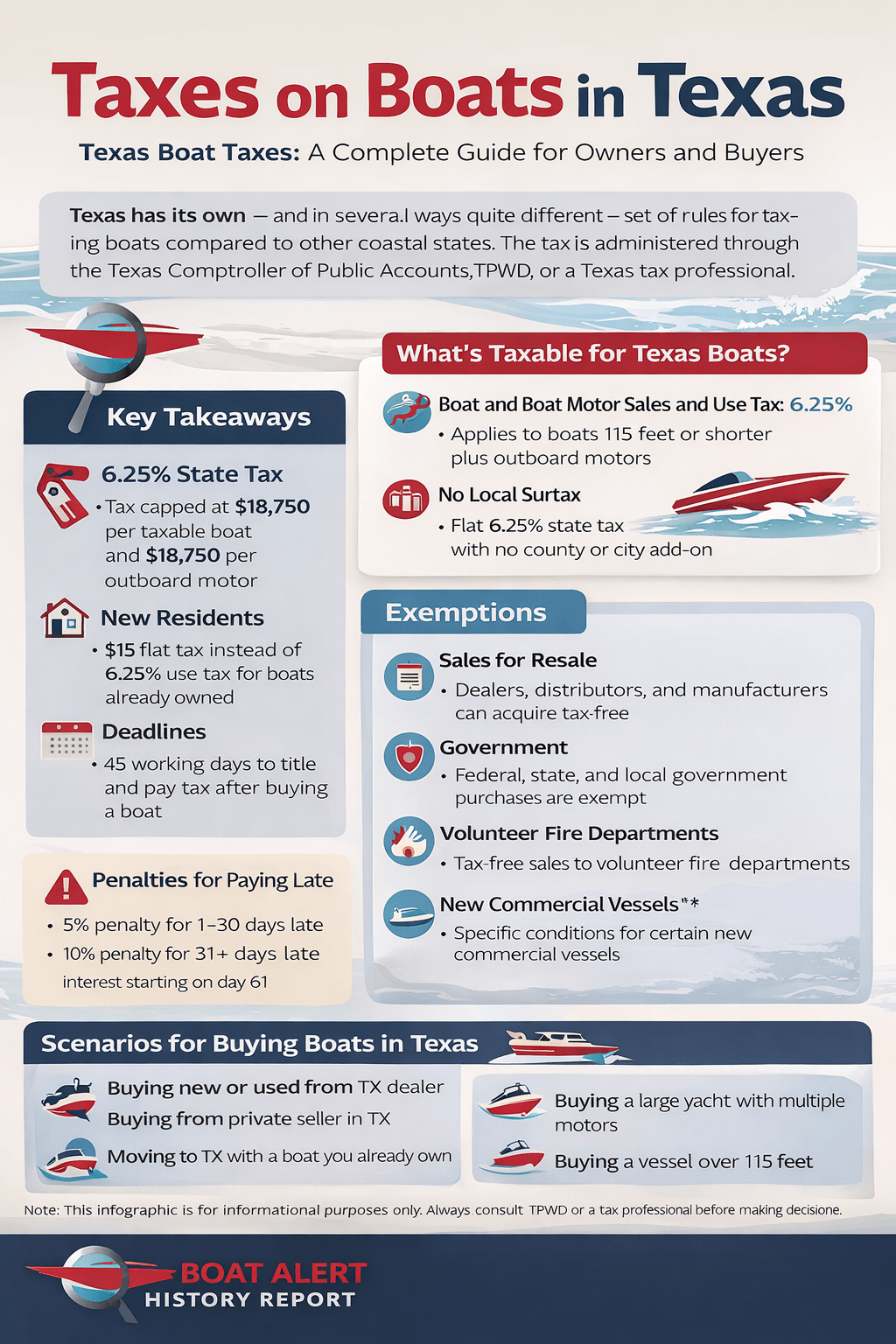
Texas has its own — and in several ways quite different — set of rules for taxing boats compared to other coastal states. The tax is administered through the Texas Parks and Wildlife Department (TPWD) rather than a DMV or the general sales tax system, the tax cap works per-item instead of per-sale, and moving to Texas with a boat you already own comes with an unusually generous break. This guide walks through what’s taxable, what’s exempt, deadlines, and how the rules apply across common scenarios.
This article is general information, not tax or legal advice. Confirm your specific numbers with the Texas Comptroller of Public Accounts, TPWD, or a Texas tax professional before a purchase or move — the cap, exemptions, and deadlines all have real dollar consequences.
Key Takeaways
- Texas charges a 6.25% Boat and Boat Motor Sales and Use Tax on boats 115 feet or shorter, plus outboard motors, sold or used in Texas.
- Unlike many coastal states, there’s no county or local add-on to this tax — it’s a flat state rate, with no discretionary surtax.
- Tax is capped at $18,750 per taxable boat and separately at $18,750 per outboard motor — so a boat sold with more than one motor can generate more than $18,750 in total tax.
- Boats over 115 feet aren’t covered by this tax at all — they’re taxed under Texas’s general Limited Sales, Excise and Use Tax instead (6.25% state plus up to 2% local, with no cap).
- Tax is due, and the boat must be titled, within 45 working days of the sale or of the boat’s arrival in Texas.
- New Texas residents bringing a boat they already own pay a flat $15 tax instead of the full 6.25% use tax — one of the more generous provisions of any state.
- Late payment triggers a 5% penalty, rising to 10% after 30 days, plus interest starting on day 61.
What’s Taxable for Texas boats?
Boat and Boat Motor Sales and Use Tax (6.25%)
Texas imposes a 6.25% tax on the retail sale of any “taxable boat” — defined as a vessel 115 feet or shorter, including motorboats, sailboats, and motorized personal watercraft — and on outboard motors (gas, diesel, or an electric motor like a trolling motor sold together with the boat). The tax is based on the sale price after subtracting any trade-in allowance.
No Local Surtax
This is one of the clearest differences from states like Florida: there’s no county or city add-on for boats taxed under this chapter. The 6.25% state rate is the whole story — you won’t see a variable local rate stacked on top the way you would with a car purchase in Texas, or a boat purchase in a state with a county-level boat surtax.
The $18,750 Cap — and Why It’s Per Item, Not Per Sale
Since September 1, 2019, Texas caps the sales tax on a single taxable boat at $18,750 (6.25% of $300,000). The important nuance: that cap applies separately to the boat and to each outboard motor sold with it. The Comptroller’s own example illustrates this — a $350,000 boat sold with two $9,000 outboard motors would owe $18,750 in tax on the boat itself (capped, since 6.25% of $350,000 would otherwise be $21,875), plus 6.25% tax on each motor ($562.50 each, uncapped since motors are far under $300,000), for a combined total of $19,875. If you’re buying a high-value boat with multiple motors, don’t assume the $18,750 figure is your absolute ceiling — get an itemized breakdown.
Boats Over 115 Feet
Vessels longer than 115 feet fall outside this chapter entirely and are instead taxed under Texas’s general Limited Sales, Excise and Use Tax: 6.25% state tax plus up to 2% in local tax (city, county, transit authority, or special district), for a combined rate as high as 8.25% — and with no cap.
Boat Trailers
Trailers are legally classified as motor vehicles in Texas, not boats. They’re taxed separately through the county tax office under standard motor vehicle sales tax rules (6.25% plus up to 2% local), and the trailer’s price must be itemized separately from the boat and motor on the invoice.
Paddle Craft and Similar Vessels
Canoes, kayaks, inflatable rafts, punts, and other vessels designed to be propelled only by paddle, oar, or pole aren’t covered by the boat and boat motor tax — but that doesn’t make them tax-free. They’re simply taxed under Texas’s general sales and use tax rules instead.
Use Tax for Boats Brought Into Texas
If you’re a Texas resident who buys a boat or motor in another state and brings it into Texas, you owe a 6.25% use tax — the same rate as the sales tax, and you’ll get credit for any legitimate sales or use tax you already paid to the other state. The important catch: the use tax has no $18,750 cap. That cap only applies to boats sold at retail inside Texas, so a high-value boat purchased out of state and later brought to Texas could owe considerably more in use tax than it would have owed in sales tax if bought here.
The New Resident Exception
If you’re moving to Texas and bringing a boat or motor you already owned and had titled or registered elsewhere, you don’t pay the 6.25% use tax at all. Instead, you pay a flat $15 New Resident Tax per boat and per motor (so a boat and a separate outboard motor would be $30 total), once you can show you’ve genuinely relocated — typically with a new Texas driver’s license, a home lease or deed, or similar proof.
When Tax and Title/Registration Are Due
Tax is due, and the boat must be titled and/or registered, within 45 working days of the date of sale or the date the boat is first brought into Texas (this replaced a shorter 20-working-day window for purchases before September 1, 2019). Titling and tax collection happens through TPWD headquarters in Austin, a TPWD law enforcement field office, or a participating county tax assessor-collector — not through the state DMV, which surprises a lot of buyers moving from other states.
Trade-In Allowance
Tax is calculated on the sale price minus the value of any boat or boat motor traded in as part of the same transaction — there’s no need to go through a licensed dealer specifically for this deduction to apply, though the trade-in details must be documented on the bill of sale or application.
Exemptions
Sales for resale. Dealers, distributors, and manufacturers can acquire a boat or motor tax-free if it’s purchased exclusively for resale.
Government and volunteer fire department sales. Sales to the federal government, Texas state agencies, and Texas cities, counties, and other political subdivisions are exempt, as are sales to volunteer fire departments. Notably, general nonprofit status by itself does not exempt an organization from this tax — a common misconception.
Certain new commercial vessels. A vessel purchased new from its builder or manufacturer, used specifically for commercial purposes, longer than 65 feet, and meeting a minimum displacement threshold can qualify for an exemption — a narrow category aimed at commercial shipping and fishing vessels rather than recreational boats.
Nonresident/temporary use permit. An owner who qualifies under the state’s nonresident exemption provisions can obtain a temporary use permit (currently a $150 fee) that allows a boat to be used in Texas for a limited time without triggering the full tax. Terms and conditions are specific, so confirm current details with TPWD or the Comptroller before relying on this.
Penalties and Interest
- 1–30 days late: a 5% penalty on the tax due.
- More than 30 days late: an additional 5% penalty, for 10% total.
- Interest: begins accruing on the 61st day after the due date, at the state’s published rate.
Filing your title/registration application (and paying) within the 45-working-day window avoids all of this.
Which Scenario Are You In?
Buying new or used from a Texas dealer. The dealer collects 6.25% tax on the boat (capped at $18,750) plus 6.25% on each motor separately, less any trade-in. Get an itemized quote if your total price is near or above $300,000, since the per-item cap can mean paying more than $18,750 overall.
Buying from a private seller in Texas. You’re responsible for paying the tax yourself when you title the boat — within 45 working days — using a signed bill of sale to establish the price and date.
Moving to Texas with a boat you already own. This is where Texas is notably generous: instead of the 6.25% use tax, you’ll likely qualify for the flat $15 New Resident Tax per boat and per motor, as long as you can document your move.
Texas resident buying a boat out of state and bringing it home. You’ll owe the 6.25% use tax (with credit for tax already paid elsewhere) — but unlike an in-state purchase, there’s no $18,750 cap, so this route can cost more than buying the same boat from a Texas dealer if the price is high.
Buying a large yacht with multiple motors. Don’t assume $18,750 is your final number — the cap applies separately to the boat and to each motor, so a boat with two or three motors can push the real total several thousand dollars past that figure.
Buying a vessel over 115 feet. You’re outside the boat-specific tax chapter entirely and into Texas’s general sales tax system — expect a combined state-plus-local rate up to 8.25% with no cap, rather than the $18,750 ceiling.
Buying a kayak, canoe, or other paddle craft. These fall outside the boat and boat motor tax, but they’re still subject to Texas’s regular sales tax rules — there’s no blanket exemption just because the boat isn’t motorized.
FAQ for Boat Taxes in Texas
What’s the boat sales tax rate in Texas? 6.25% on boats 115 feet or shorter and on outboard motors, with no additional county or city tax.
Is there really an $18,750 cap? Yes, but it applies separately to the boat and to each motor sold with it — so total tax on a boat with multiple motors can exceed $18,750.
What if I buy a boat out of state and bring it to Texas? You’ll owe a 6.25% use tax with credit for tax already paid elsewhere, and this use tax has no cap — unless you’re a new Texas resident, in which case a flat $15 tax applies instead.
How long do I have to title and pay tax after buying a boat? 45 working days from the date of sale or the date the boat arrives in Texas.
Who handles boat titling in Texas — the DMV? No. Texas Parks and Wildlife Department (TPWD) handles boat and motor titling and tax collection, through TPWD offices or participating county tax assessor-collectors.
Are nonprofits exempt from Texas boat tax? Generally no. Exemptions are limited mainly to government entities and volunteer fire departments, not nonprofits as a category.
What happens if I pay Texas boat tax late? A 5% penalty applies immediately after the due date, rising to 10% after 30 days, with interest starting on day 61.
Are trailers taxed the same as the boat? No — trailers are taxed separately as motor vehicles through the county tax office, not under the boat and boat motor tax.
#Boat #taxes #Texas
Read Related Articles:
- All you wanted to know about Hull ID Numbers
- North Carolina Boat Registration
- Why Every Boater Needs the Right Insurance — And How to Get a Quote That Actually Makes Sense
- Best Marine Surveyors in Crystal River
- Delaware Boat Registration
Categories: To learn more about Boat-Alert.com History Reports for used boats and boatfax hin search title report visit: www.Boat-Alert.com