Boat Registration Lookup Sites: Expert Comparison
Finding reliable information about a boat’s history before you buy shouldn’t require searching a dozen different databases. Yet that’s exactly what many buyers face when they try to verify registration, check for theft records, or uncover hidden liens on a used vessel.
This guide compares the best registration lookup sites for boats available and explains what each type of service actually searches. It also walks you through how to interpret results so you can spot red flags before money changes hands.
What is a boat registration lookup
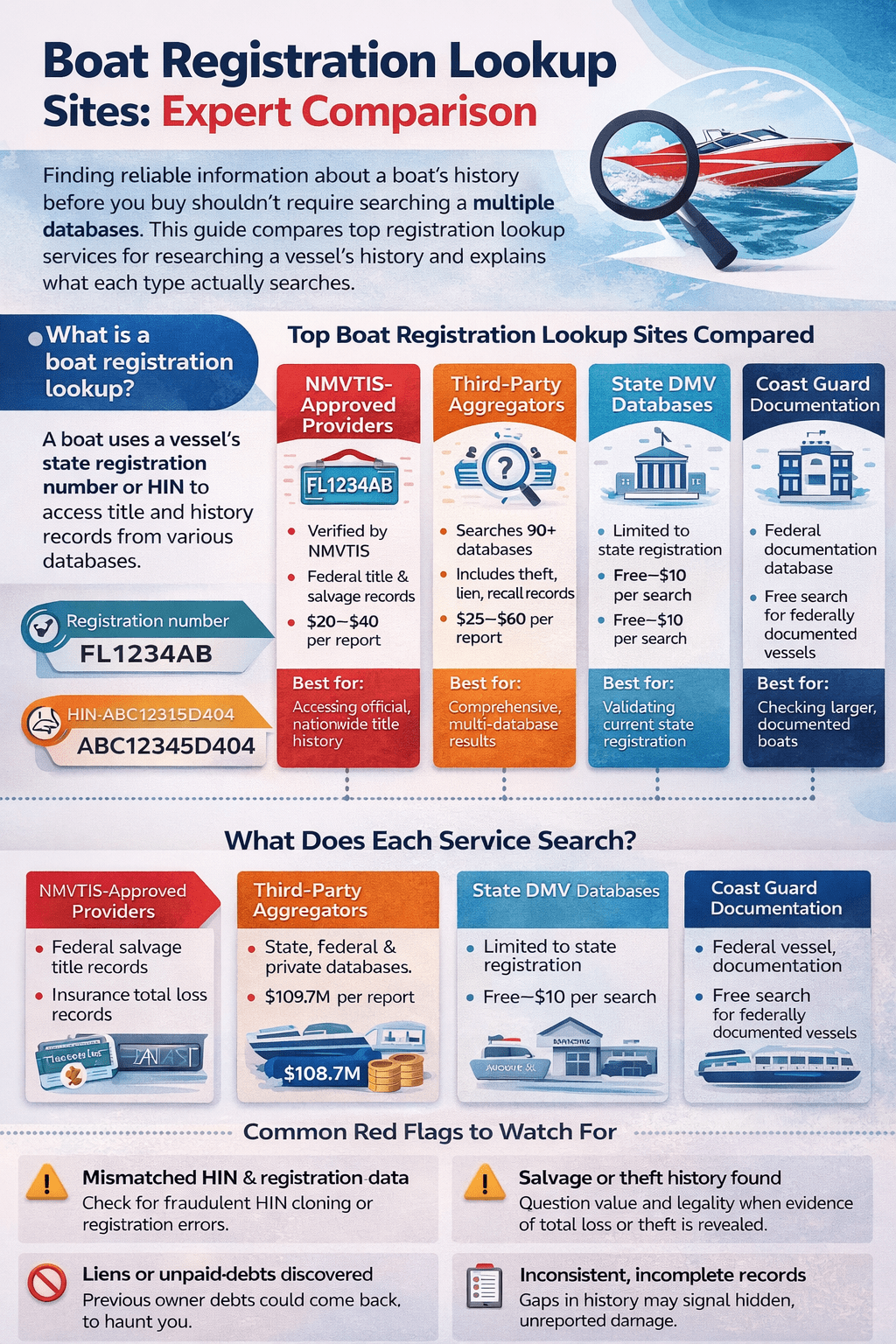
Top boat registration lookup sites include NMVTIS-approved providers for federal title and salvage records. Options also include third-party aggregators that search 90+ databases at once, and free options like the Coast Guard documentation search for federally documented vessels.
A boat registration lookup uses a vessel’s state-issued registration number or Hull Identification Number (HIN). It pulls ownership, title, and history records from public and private databases.
If you’re familiar with car license plate lookups, the concept is similar—but boats use different identifiers:
- Registration number: A state-assigned identifier displayed on the hull, like a license plate. This number changes if the boat moves to a different state.
- HIN (Hull Identification Number): A 12-character serial number stamped into the transom by the manufacturer—stays with the boat permanently.
- Documentation number: A federal identifier issued by the Coast Guard for vessels used in commerce or international waters, typically larger boats.
Most lookup services accept either the registration number or HIN. Some can perform reverse lookups, finding the HIN when you only have a registration number. For a step-by-step overview of the entire process, see our free boat history check guide.
Best registration lookup sites for boats compared
Your choice among the best registration lookup sites depends on what you actually want to find out. For basic registration verification, a state DMV search might work.
Need comprehensive history including theft, salvage, and liens? You’ll want a service that pulls from multiple databases.
| Service Type | Database Access | Typical Cost | Best For |
|---|---|---|---|
| NMVTIS-Approved Providers | Federal title/salvage records | $20–$40 | Comprehensive history |
| Third-Party Aggregators | 90+ databases combined | $25–$60 | One-stop searches |
| State DMV Databases | State registration only | Free–$10 | Basic verification |
| Coast Guard Documentation | Federal documentation records | Free | Documented vessels |
NMVTIS-approved boat history providers
The National Motor Vehicle Title Information System (NMVTIS) is a federal database maintained by the Department of Justice. Approved providers can access title brands, salvage history, and total loss records reported by insurance companies and salvage yards.
Here’s the catch: not all NMVTIS providers offer boat lookups. Many focus exclusively on cars and trucks. When evaluating a service, confirm it specifically covers watercraft and pulls from marine-specific sources beyond just NMVTIS.
Third-party boat history report services
Services like Boat Alert aggregate data from dozens of sources into a single report. Instead of searching each database individually—which could take hours—you get results from federal, state, insurance, auction, and theft databases in one search.
A comprehensive report typically covers theft records (domestic and international), accident history, salvage and total loss declarations, liens, recalls, and registration records across multiple states. The time savings alone make these services worth considering when you’re serious about a purchase.
State DMV and Coast Guard registration databases
Some states offer free or low-cost registration lookups directly through their DMV websites. Coverage varies dramatically, though. Florida provides relatively accessible records, while other states require in-person requests or restrict information due to privacy laws.
The Coast Guard’s documentation search at the National Vessel Documentation Center is free and covers federally documented vessels. Keep in mind this database only includes boats with federal documentation—most recreational boats are state-registered only and won’t appear here.
Free vs. paid boat registration lookup tools
Free lookups confirm current registration status and basic vessel information. That’s useful for quick verification, but free searches usually miss the details that matter most to buyers.
- Free lookups typically include: Current registration status, basic vessel description, registration expiration
- Paid lookups typically include: Theft records, accident history, salvage/total loss declarations, liens, previous owners, manufacturer recalls, auction history
A free search won’t reveal if the boat was declared a total loss after a hurricane. It also won’t show if it’s currently reported stolen in another state.
Why boat buyers run a registration lookup before purchase
A physical inspection tells you the boat’s current condition. A registration lookup reveals its past—and that past can include problems no sea trial will uncover. Learn more about what to expect from a pre-purchase boat survey.
Verify ownership and title status
Running a lookup confirms the seller actually owns the boat and has clear title to transfer. Review our guide on boat buying strategies for more tips. Title jumping—where a seller never registers the boat in their name—creates legal complications that can follow you for years after purchase.
Uncover hidden liens and claims
Liens from lenders, marinas, or mechanics don’t show up during a walkthrough. Our boat lien check guide explains where these debts are recorded. If the previous owner still owes money on the vessel, that debt can become your problem after the sale closes.
Check for theft and salvage history
Stolen boats are regularly resold with falsified paperwork. Salvage titles indicate the boat was previously declared a total loss by an insurance company. Both situations create serious legal and financial headaches for buyers who don’t check first.
Confirm the HIN matches registration paperwork
HIN cloning is a real scam where thieves stamp a legitimate HIN onto a stolen boat. Cross-checking the physical HIN against registration records helps verify the numbers match and haven’t been altered. Read more about boat title washing and HIN fraud.
What information does a boat registration search reveal
A comprehensive lookup pulls data from multiple categories. Here’s what you can expect to find in a detailed report:
Registration and documentation records
Registration records show the registered owner (where state privacy laws allow), registration state, expiration date, and any documentation numbers for federally documented vessels. Some reports include previous registration states, revealing where the boat has been over its lifetime.
Theft and recovery indicators
Lookups check domestic theft databases and, in some cases, international stolen vessel records. You’ll also see if a boat was previously reported stolen and later recovered—which can affect its value and insurability.
Accident and salvage history
Insurance total loss declarations, salvage auction records, and accident reports indicate prior damage—3,887 boating accidents in 2024 resulted in approximately $88 million in property damage alone. A boat that looks pristine today might have been underwater during a hurricane two years ago.
Manufacturer data and HIN validation
HIN decoding extracts the manufacturer, model, year, and production sequence from the number itself. Validation confirms the HIN format is legitimate and matches the claimed manufacturer—a useful check against altered or fabricated numbers.
How to look up a boat registration number
1. Locate the HIN or registration number on the vessel
Find the HIN on the starboard side of the transom (the flat back of the boat) or in another Coast Guard-approved location. Registration numbers are typically displayed on both sides of the bow. Photograph both for your records before running any search.
2. Choose a registration lookup service or database
Select based on what you want to learn. For basic registration verification, a state DMV search might suffice. For comprehensive history before a purchase, choose a service that aggregates multiple databases including theft, salvage, and lien records.
3. Enter the number and run the search
Most services accept either the HIN or registration number. Enter the number exactly as it appears—spacing and formatting matter. Some services offer reverse lookups if you only have one identifier.
4. Review and interpret your results
Look for red flags: mismatched information between the HIN and registration, salvage or total loss brands, active theft alerts, or unexplained gaps in history. Run your report before making an offer, not after you’ve already committed.
Tip: Share your history report with your marine surveyor. It helps them target high-risk areas during the physical inspection.
Free boat registration lookup options and their limits
Coast Guard documentation center search
The National Vessel Documentation Center offers free searches for federally documented vessels. You can verify documentation status, see the vessel’s official name, and check for recorded liens. However, this database only covers documented vessels—most recreational boats under 26 feet are state-registered only and won’t appear.
State registration database access
Availability varies significantly by state. Some offer online searches, others require written requests or in-person visits. Privacy laws in many states restrict what information can be disclosed to the public, often limiting results to basic registration status without owner details.
Why free lookups often miss critical data
Free searches typically don’t include theft databases, salvage records, insurance total loss data, liens, or accident history. You’ll confirm the boat is currently registered. But you won’t know if it was totaled in a flood last year or reported stolen in another state.
Is it legal to search boat registration information
Searching publicly available registration information is legal. These are public records, similar to property records or court filings. However, access to owner personal information varies by state privacy laws—some states restrict name and address disclosure to the general public.
Legitimate lookup services only provide data they’re authorized to share. They aggregate public records and licensed database access, not private information obtained through improper means.
What databases do boat registration lookup services search
Federal databases including NMVTIS
NMVTIS contains title and salvage data reported by all insurance carriers and salvage yards as well as state DMVs. Services with NMVTIS access can reveal total loss declarations and title brands that state-only searches miss entirely.
State title and registration systems
Comprehensive services query multiple state DMV databases, revealing registration history across different states. This matters because boats frequently change hands across state lines and not all states require boats to be titled, so problems in one state don’t always follow the paperwork to the next.
Insurance and salvage auction records
Total loss records from insurance companies and salvage auction history reveal boats that were damaged and resold. Some services track specific auction platforms where damaged vessels are sold to rebuilders.
International theft and recovery databases
For boats that could have crossed borders, international theft databases provide additional coverage. This is particularly relevant for vessels in coastal areas or near the Canadian border.
Red flags to watch for in boat registration results
Mismatched HIN and registration data
When the HIN on the boat doesn’t match registration records, stop and investigate. This could indicate HIN tampering, clerical errors, or outright fraud. Don’t proceed without resolution.
Salvage or total loss title brands
A salvage brand means an insurance company declared the boat a total loss. The vessel may have been repaired and resold, but this history affects value, insurability, and potentially safety. Some states don’t require disclosure of salvage history, making a lookup essential.
Active theft or stolen boat alerts
Buying a stolen boat means losing both the boat and your money when it’s recovered by authorities. Walk away from any vessel with theft indicators, no matter how good the deal seems.
Missing or incomplete boat history
Gaps in history could indicate the boat changed hands outside normal channels—private sales without proper title transfer, or worse. Not always fraud, but worth investigating further before committing.
Limitations of boat registration lookups
No search service can guarantee complete history. Set realistic expectations about what a lookup can and cannot reveal:
- State privacy laws: May restrict owner information disclosure
- Database gaps: Not all incidents are reported to searchable databases
- Historical records: Older boats may have limited digital history
- International vessels: Foreign registration history may be unavailable
A lookup complements but doesn’t replace a physical inspection and marine survey. Think of it as one layer of protection in your due diligence process. See our frequently asked questions for more details on what reports cover.
How to choose the right boat history report service
Evaluate database coverage and report depth
Look for services that search federal, state, and private databases—the more sources, the more complete the picture. Ask what categories the report covers: theft, salvage, liens, recalls, accidents, and registration history across multiple jurisdictions.
Compare pricing and guarantee policies
Single-report prices typically range from $25 to $40. Multi-report packages offer savings if you’re comparing several boats.
Look for money-back guarantees that protect you if the report doesn’t deliver what’s promised—a 60-day window gives you time to verify the information. Compare options in our Carfax for boats comparison.
Run a professional boat history report today
Before you commit to any used boat purchase, run a comprehensive boat history report to uncover problems that inspections alone can’t reveal.
FAQs about boat registration lookups
Lookup by registration number only, without the HIN?
Yes, many boat registration lookup services accept either the state registration number or the HIN to run a search. Some can perform a reverse lookup to find the HIN from a registration number, though results depend on database coverage for your state.
How long does it take to get boat registration lookup results?
Most online boat history report services deliver results instantly or within minutes after you enter the registration number or HIN. Services that require manual research may take longer.
Do boat registration lookups work for jet skis and personal watercraft?
Yes, jet skis and personal watercraft have HINs and registration numbers just like boats. The same lookup services can search their history using identical methods.
What is the difference between a boat registration number and a HIN?
The registration number is assigned by your state when you register the boat and may change if the boat moves to a new state. The HIN is a permanent serial number assigned by the manufacturer that stays with the boat for life—similar to a vehicle VIN.
Finding a boat’s previous owner via registration lookup
Some boat history reports include previous owner information where available. However, state privacy laws restrict access to personal details in many cases, so results vary by state and database.
Do boat registration lookups include Canadian vessels?
Some boat history services search both U.S. and Canadian registration and licensing databases. If you’re considering a boat that may have Canadian history, verify the service you choose offers cross-border coverage before purchasing a report.
Categories: To learn more about Boat-Alert.com History Reports for used boats and hin boat visit: www.Boat-Alert.com