Do Boat History Reports Have to Be Requested by the Boat Owner?
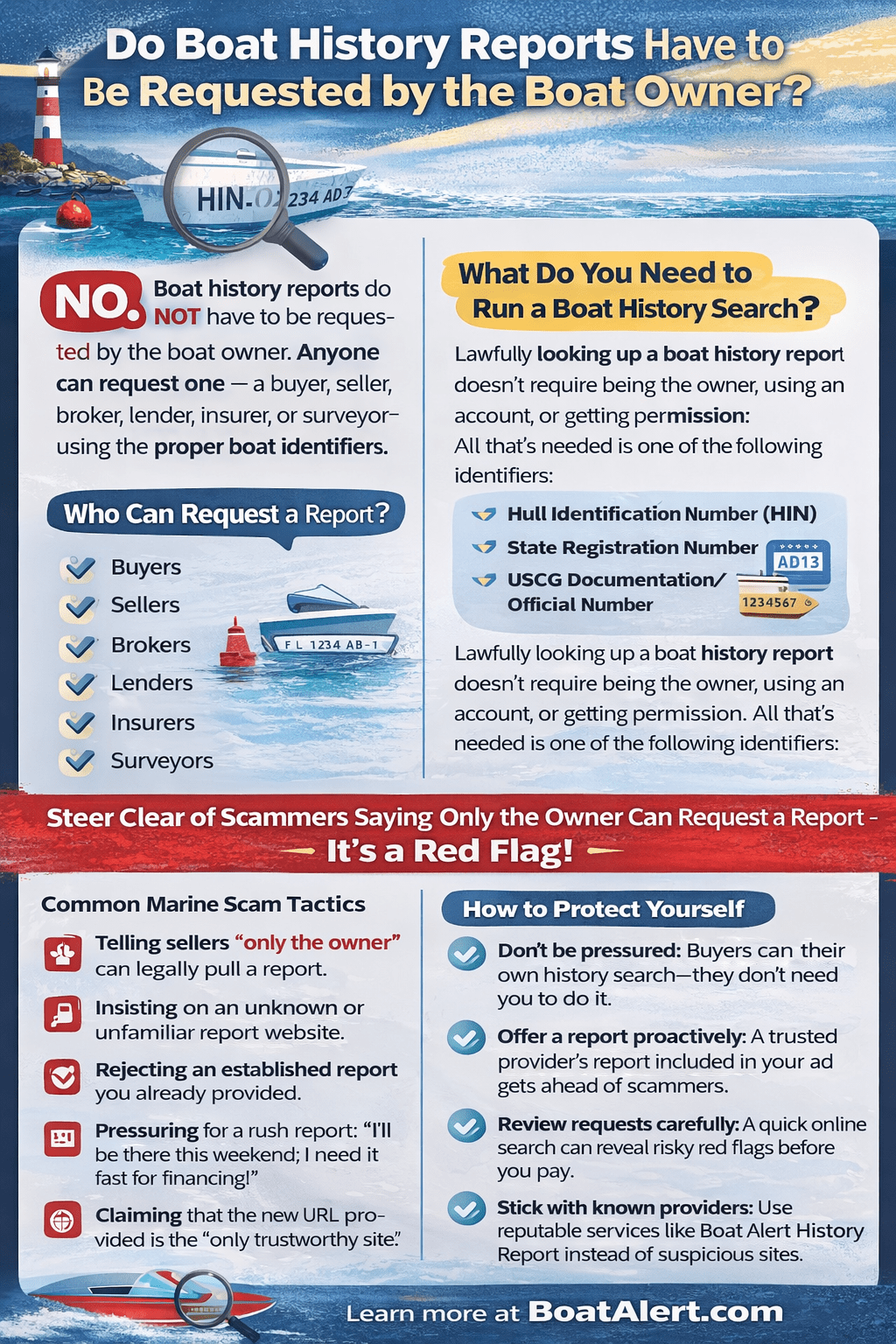
No, Boat Alert history reports do not have to be requested by the boat owner. Anyone — a buyer, a seller, a broker, a lender, or an insurer — can run one, as long as they have the boat’s Hull Identification Number (HIN), state registration number, or U.S. Coast Guard documentation/official number. Ownership of the boat has nothing to do with who is allowed to pull the boat history report.
This is an important thing to know right now, because a growing scam in the marine industry relies on buyers convincing sellers that the opposite is true.
What You Actually Need to Run a Boat History Search
A boat history search works off the vessel itself, not the person requesting it. The three identifiers that unlock a report are:
- Hull Identification Number (HIN) — the boating equivalent of a car’s VIN. It’s a 12-character code stamped into the transom, usually in the upper right corner or under the swim platform, and it’s also printed on the title, registration, and insurance paperwork.
- State registration number — assigned by the state where the boat is titled or registered.
- USCG documentation/official number — assigned to vessels documented with the U.S. Coast Guard’s National Vessel Documentation Center rather than titled through a state.
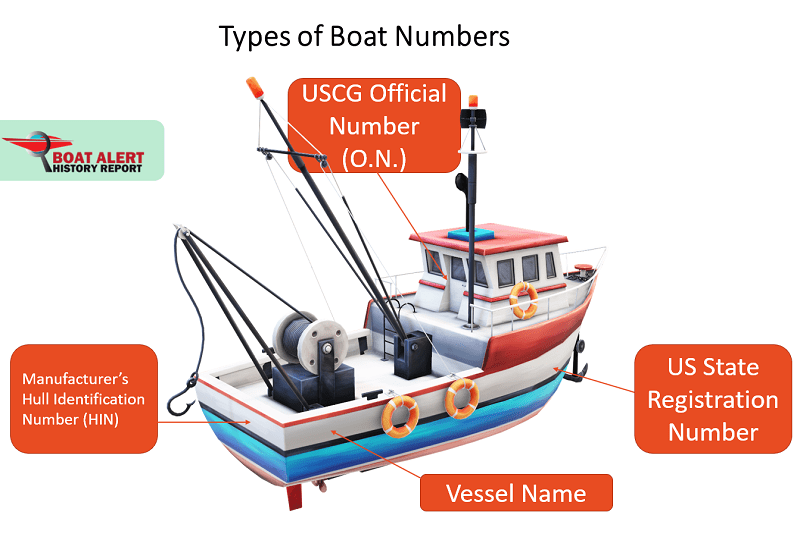
Any of these three numbers is enough for a third-party provider to search public and vetted private databases and compile a report. None of them require the owner’s login, signature, or permission to look up.
Who Can Actually Request One
- Buyers researching a boat before making an offer or scheduling a viewing
- Sellers and dealers who want to get ahead of buyer questions by including a report in the listing
- Yacht brokers doing due diligence before representing a vessel
- Lenders underwriting a marine loan
- Insurers evaluating a policy or a claim
- Surveyors cross-checking the hull number against paperwork before an inspection
In short, this is a public-facing lookup service, not a private account tied to an owner’s identity — similar to how anyone can run a Carfax or AutoCheck report on a used car with just the VIN.
What a Boat History Report Typically Shows
A comprehensive report usually pulls from state title and registration records, USCG documentation records, insurance total-loss and salvage databases, and stolen-boat databases. Depending on the provider, it can flag:
- Prior collision, fire, or grounding damage
- Flood or hurricane exposure
- Salvage or total-loss history
- Theft records
- Title and lien status
- Registration history and prior owners
- Confirmation that the HIN on the hull matches the paperwork
- See the full list on the order page.
For boats that are USCG-documented rather than state-titled, a full Abstract of Title from the National Vessel Documentation Center is the most authoritative record of ownership transfers and liens — and, again, anyone can request one; it isn’t restricted to the current owner.
The “Owner-Only” Scam: How It Works
According to a July 2025 IYBA (International Yacht Brokers Association), a scam that’s long been common with used-car listings has now spread to the boating market. It typically plays out like this:
- A boat is listed for sale on a brokerage site, classifieds page, or social media.
- A “buyer” reaches out quickly, often pushing for an urgent weekend viewing.
- Before agreeing to see the boat, the buyer asks the seller to supply a history report — and falsely claims that only the owner is able to request one.
- If the seller offers a report from an established provider, the buyer rejects it and insists on a specific, unfamiliar website instead.
- Once the seller pays for that report, the buyer disappears — no viewing, no purchase, and no refund.
Beyond the direct financial loss, sellers who follow through on this can end up handing over personal and payment details to the scammers on that fake site, opening the door to further fraud.
A Boat-Alert report can help you sell your boat faster and for a higher price while gaining trust of the buyer, but you should only order it from the official website.
Red Flags to Watch For
- A buyer who won’t run their own report and insists the seller must do it
- A claim that “only the owner can legally request” a history report — this is simply not true
- Pressure to use one specific, unfamiliar report site instead of an established provider
- Rejecting a legitimate report you’ve already offered, with vague excuses
- Urgency or emotional pressure (“I need this today for a loan approval,” “I only trust this site because of a bad past experience”)
How to Protect Yourself
- Don’t be pressured. A legitimate buyer is capable of running their own history search with the HIN or registration number — they don’t need the seller to do it.
- Offer a report proactively. Including a report from a recognized provider directly in the listing removes the scammer’s main pressure point.
- Slow down and verify. Before paying for anything, check how long the requested site has existed, whether it uses a secure connection, and whether it has verifiable contact information and reviews. A quick WHOIS lookup on an unfamiliar domain can reveal how new — and how suspicious — it is.
- Stick with known providers. Established services with a track record in the marine industry are the safer choice over a link a stranger insists on.
- Report it. If you encounter this scam, flag it to your local marine industry association and to the report provider being impersonated, so others can be warned.
Bottom Line
Boat history reports are tied to the vessel’s identification number, not to the owner’s identity — anyone can request one. If a prospective buyer insists otherwise and pushes you toward an unfamiliar site to buy a report, treat it as a warning sign rather than a requirement, and consider reviewing the full breakdown from IYBA for more on how this scam operates and how to respond.
BoatHistoryReport #BoatBuyingTips #HullIdentificationNumber #BoatScamt #UsedBoatBuying #YachtBrokers #BoatDealers #MarineFraudPrevention #BoatHIN #BuyerBewareScam #BoatingSafety #BoatOwnership
Categories: To learn more about Boat-Alert.com History Reports for used boats and boat hull id number lookup visit: www.Boat-Alert.com