Boats Without HIN Numbers: What to Know
Introduction
Owning a boat can be an exciting venture, offering freedom on the water for recreation, fishing, or cruising. However, boats without a Hull Identification Number (HIN) can present unique challenges, particularly in terms of registration, ownership verification, and legal compliance.
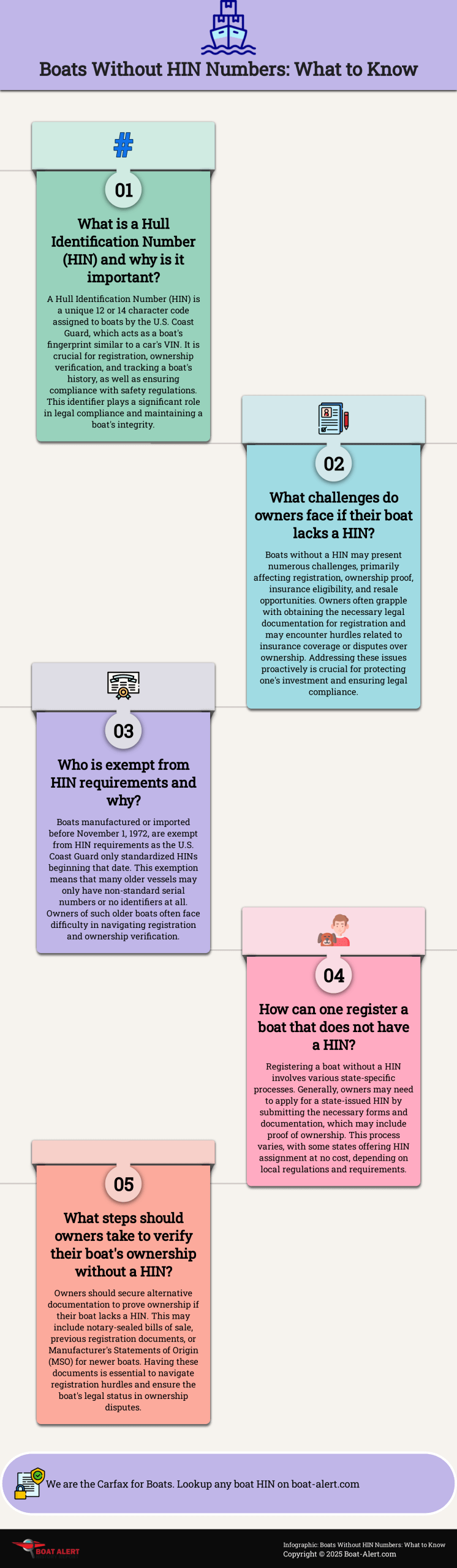
The HIN, a unique 12-character code, serves as a boat’s fingerprint, akin to a car’s Vehicle Identification Number (VIN). Boats manufactured or imported before November 1, 1972, are exempt from HIN requirements, which can complicate matters for owners of older or homemade vessels.
This article explores the importance of the HIN, the implications of owning a boat without one, the registration process, associated risks, and resources to help navigate these challenges, ensuring you can enjoy your time on the water with confidence.
Understanding the Hull Identification Number (HIN)
The Hull Identification Number (HIN) is a unique identifier assigned to boats, mandated by the U.S. Coast Guard for all vessels manufactured or imported on or after November 1, 1972. Similar to a car’s VIN, the HIN consists of 12 or 14 characters, including letters and numbers, and provides critical information about the boat, such as:
- Manufacturer Identification Code (MIC): The first three characters, assigned by the U.S. Coast Guard, identify the manufacturer (e.g., “XYZ” for a specific brand).
- Serial Number: The next five characters are a unique serial number assigned by the manufacturer.
- Date of Manufacture: The following characters indicate the month and year of manufacture (e.g., “D4” for April, with the year in the last two digits).
- Model Year: The final two characters denote the model year.
See How to read a HIN.
The HIN is typically found on a metal or plastic plate on the starboard (right) side of the transom, within two inches of the top of the transom, gunwale, or hull/deck joint. For boats without a transom, such as canoes, it’s affixed to the starboard outboard side near the stern. A second HIN is often placed in a hidden location, such as under a fitting or inside the hull, to aid in theft recovery. The HIN is essential for:
- Registration: Required by most states to register a boat, ensuring it can be legally operated on public waters.
- Ownership Verification: Helps prove ownership, especially during sales or disputes.
- Tracking History: Allows authorities and owners to track a boat’s history, including theft, liens, or recalls.
- Safety Compliance: Ensures the boat meets U.S. Coast Guard safety standards.
Altering or removing a HIN without authorization from the U.S. Coast Guard is illegal, emphasizing its importance in maintaining a boat’s legal and historical integrity (BoatUS).
Boats Without HIN: Why It Happens
Boats may lack a HIN for several reasons, primarily due to their age or construction:
- Pre-1972 Vessels: Boats built or imported before November 1, 1972, are exempt from HIN requirements, as the U.S. Coast Guard standardized HINs starting that year. Many older boats, such as those from the 1960s, may only have a non-standard serial number or no identifier at all (Georgia Wildlife).
- Homemade Boats: Vessels built by individuals for personal use may not have a manufacturer-assigned HIN, though states or the U.S. Coast Guard can issue one.
- Imported Boats: Some boats imported from countries with different identification standards may lack a U.S.-compliant HIN.
- Tampering or Damage: In rare cases, a HIN may have been removed, altered, or damaged, raising concerns about potential theft or fraud.
The absence of a HIN can lead to significant challenges, including difficulties in registration, proving ownership, obtaining insurance, and reselling the boat. Owners of such boats must be proactive in addressing these issues to ensure legal compliance and protect their investment.
Registering a Boat Without a HIN
Registering a boat without a HIN is possible but varies significantly by state, as each has its own regulations and procedures. Most states require motorized boats and certain non-motorized vessels (e.g., sailboats over a specific length) to be registered, regardless of HIN status. For boats without a HIN, the following general steps apply:
- Apply for a State-Issued HIN: Many states, such as California and Wisconsin, allow owners to request a HIN for vessels lacking one. For example, in California, the Department of Motor Vehicles (DMV) can assign a HIN at no cost upon submission of a California Certificate of Ownership and a Statement of Facts (REG 256) form, stating the vessel lacks a HIN and providing the builder’s name if known (California DMV). State-issued HINs typically begin with the state abbreviation followed by a “Z” (e.g., “CAZ” for California or “USZ” for Coast Guard-issued numbers).
- Provide Alternative Documentation: Owners may need to submit proof of ownership, such as a notarized bill of sale, previous registration documents, or a Manufacturer’s Statement of Origin (MSO) for newer boats. In some cases, an affidavit declaring ownership may be required (Neighbor Blog).
- Inspection: Some states mandate an inspection by a licensed vessel verifier, law enforcement, or wildlife officials to confirm the boat’s identity and ensure it isn’t stolen. For instance, in Tennessee, a state patrol officer may inspect the boat before issuing a HIN.
- State-Specific Requirements: Regulations differ by state. In New York, motorized boats must be registered, and owners of boats without a HIN may need to provide additional documentation or have the boat inspected (NY DMV). In Connecticut, all motorized boats and sailboats over 19.5 feet require registration, with a specific application process for assigning a HIN (Connecticut DMV).
For pre-1972 boats, states often recognize their exemption from HIN requirements but may still require registration with alternative identifiers, such as a serial number or state-issued number. Owners should contact their state’s DMV, Department of Natural Resources, or equivalent agency to confirm specific requirements and procedures. For example, in Michigan, boats under 20 feet without a permanent motor may not need a title, but registration still requires some form of identification.
Risks and Considerations of Owning a Boat Without a HIN
Owning a boat without a HIN carries several potential risks that owners should carefully consider:
- Proving Ownership: Without a HIN, establishing legal ownership can be challenging, particularly in disputes or when selling the boat. This can lead to complications if the boat’s history is unclear or if ownership is contested.
- Insurance Challenges: Insurance companies may view boats without a HIN as higher risk, potentially refusing coverage or charging higher premiums. For example, a forum user reported that Progressive canceled their policy due to the lack of a HIN, even for basic liability coverage.
- Resale Difficulties: Boats without a HIN may be harder to sell, as buyers may suspect issues like theft or fraud. A potential buyer expressed concern about purchasing a boat without a visible HIN, highlighting the impact on marketability (The Hull Truth).
- Theft Recovery: The HIN is critical for tracking and recovering stolen boats. Without one, law enforcement may struggle to identify or return a stolen vessel, increasing the risk of loss (Boating Basics Online).
- Legal Compliance: Operating a boat without proper registration or a HIN (for post-1972 boats) may violate state or federal regulations, potentially resulting in fines or penalties. Additionally, altering or removing a HIN without U.S. Coast Guard authorization is illegal, which could raise red flags if a HIN appears to have been tampered with.
To mitigate these risks, owners should maintain thorough documentation, such as bills of sale, previous registrations, or inspection reports, and consider obtaining a state-issued HIN to enhance the boat’s legal standing.
Verifying Boat Information
For boats with or without a HIN, verifying the vessel’s history is crucial to avoid scams or hidden issues. Services like Boat-Alert provide comprehensive HIN lookup reports for $29.99 per report or $59.99 for ten searches, covering 90+ private and public databases in the U.S. and Canada. These reports include:
- Accident Checks: Identifies any reported accidents in the U.S.
- Theft Checks: Verifies if the boat has been reported stolen in the U.S. or internationally.
- Salvage and Total Loss Records: Reveals if the boat has been declared a total loss or salvaged.
- Liens and Ownership History: Provides information on liens or previous owners.
- Additional Features: Includes a boat value calculator, full HIN decoder, and checks against over 9,000 insurance companies.
These services are particularly valuable for boats without a HIN or with incomplete documentation, as they can help confirm the boat’s legitimacy and uncover potential issues like liens or salvage titles. For boats without a HIN, owners can use other identifiers, such as serial numbers or state registration numbers, to conduct partial checks, though results may be limited.
Best Practices for Boat Owners
To navigate the complexities of owning a boat without a HIN, consider the following best practices:
- Maintain Documentation: Keep all records, including bills of sale, previous registrations, and inspection reports, in a secure location. For boats with a HIN, record the number and store it separately from the vessel.
- Verify Before Purchasing: When buying a used boat, especially one without a HIN, request a notarized bill of sale and check for signs of tampering (e.g., removed or altered HIN plates). Use services like Boat-Alert to verify the boat’s history and ensure it hasn’t been reported stolen or salvaged.
- Consult Authorities: Contact your state’s DMV, Department of Natural Resources, or equivalent agency to understand registration requirements and obtain a state-issued HIN if needed. For example, in Wisconsin, owners must apply for a new HIN if the existing one doesn’t meet Coast Guard standards (Wisconsin DNR).
- Professional Inspection: Have the boat inspected by a licensed vessel verifier or marine surveyor to confirm its condition and authenticity, especially for older or homemade boats.
- International Considerations: For imported boats, ensure compliance with U.S. regulations, which may require additional documentation, such as import papers or proof of compliance with safety standards. Check with local maritime authorities for specific requirements (Transport Canada).
Buying a Boat Without a HIN
Purchasing a boat without a HIN requires extra caution to avoid legal or financial pitfalls. Here are key tips for buyers:
- Request Documentation: Ensure the seller provides a notarized bill of sale, previous registration documents, or other proof of ownership. If the boat is pre-1972, confirm its age through manufacturer records or physical characteristics (JD Power).
- Check for Tampering: Inspect the transom and other areas for signs of HIN removal or alteration, which could indicate theft or fraud. A forum user noted a buyer’s concern about a missing HIN, underscoring the importance of this step (The Hull Truth).
- Verify History: Use services like Boat-Alert or the U.S. Coast Guard’s Port State Information Exchange (CGMIX) to check the boat’s history, even if it lacks a HIN, using alternative identifiers like serial numbers.
- Consult Professionals: Engage a marine surveyor or legal expert to assess the boat’s legitimacy and assist with registration. This is particularly important for boats with no paperwork or questionable origins.
Having a HIN is important when dealing with abandonment of boats. It is a must in accordance with local laws/rules. the applicant or attorney might have to do an affidavit process. usually, boat dealers will sell boats that have a boat manufacturer HIN as part of the boat purchase and boat registration procedures. they would install the decals and take care of any hin inspection and hin formats. The ucc liens and vessel ownership would be taken care of by the dealer to avoid violations.
Conclusion
Navigating the complexities of owning a boat without a Hull Identification Number can be challenging, but with the right knowledge and resources, it’s manageable. The HIN is a critical tool for registration, ownership verification, and tracking a boat’s history, and its absence—common in pre-1972 or homemade boats—can lead to legal, insurance, and resale difficulties.
By understanding state-specific registration processes, leveraging services like Boat-Alert to verify a boat’s history, and maintaining thorough documentation, owners can mitigate risks and ensure compliance. Whether you’re purchasing a boat without a HIN or managing an existing one, proactive steps like obtaining a state-issued HIN, consulting authorities, and verifying the boat’s legitimacy can protect your investment and enhance your boating experience. Responsible ownership not only ensures legal compliance but also contributes to safer and more enjoyable waterways for all.
#HullIdentificationNumber #BoatRegistration #BoatBuying #HomemadeVessels #NoHIN
Read Related Articles:
- Sea Doo VIN Lookup (Jet Ski & PWC HIN Lookup)
- Official ‘Carfax for Boats’
- Hull Identification Number lookup – HIN Search
- Methods of Financing a boat with credit – what’s the best way?
- How to Register a Boat in New Brunswick | Vessel Licensing and Registration in New Brunswick
Categories: To learn more about Boat-Alert.com History Reports for used boats and boatfax visit: www.Boat-Alert.com