How to sell a boat in New Jersey
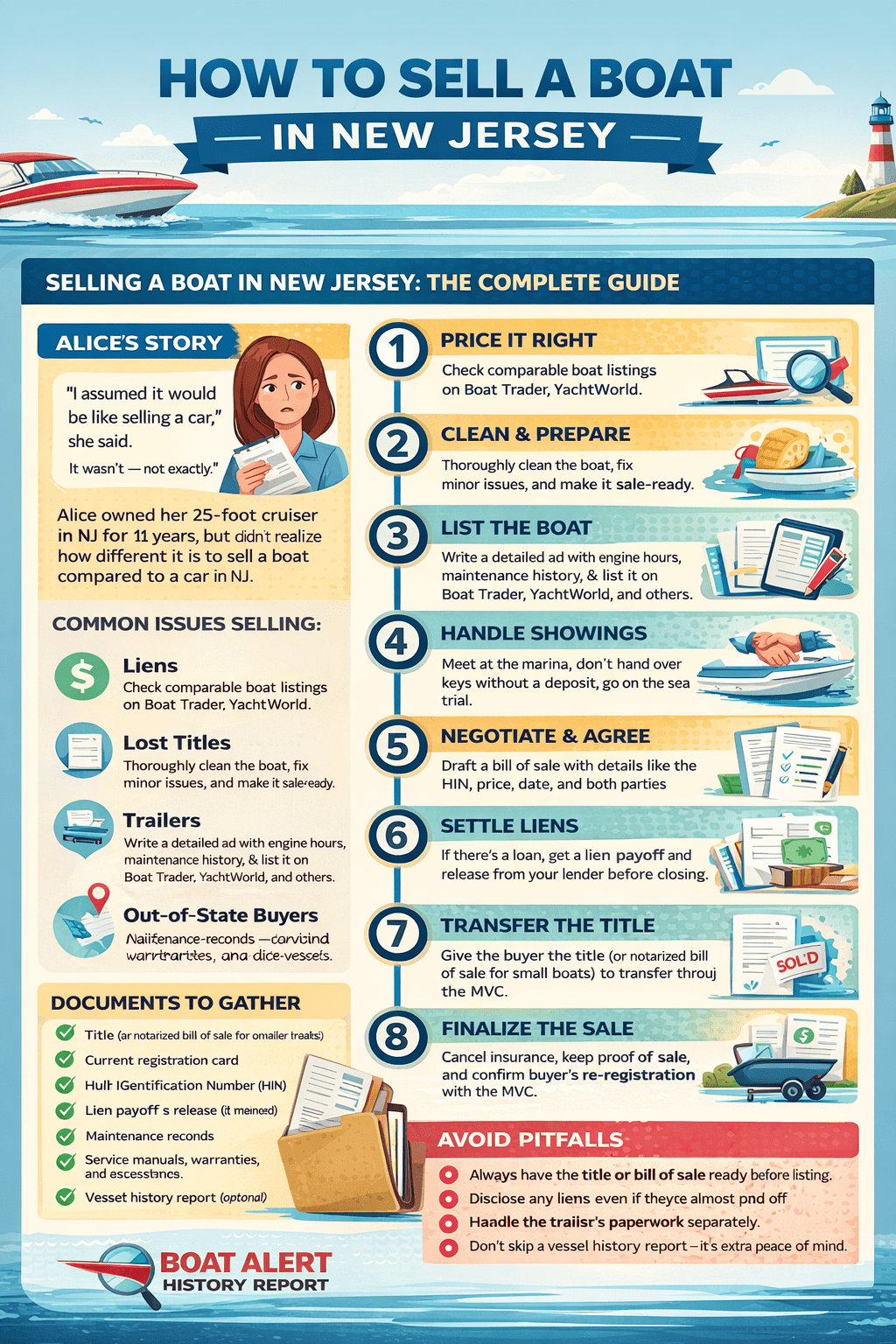
Selling a Boat in New Jersey: The Complete Guide
Alice had owned her 25-foot cruiser for eleven years. She knew the engine’s quirks, the spot on the hull that always needed a little extra wax, the exact sound it made idling out of the marina. What she didn’t know was how much paperwork stood between her and a sold boat. “I assumed it would be like selling a car,” she said. “It wasn’t — not exactly.” Between tracking down her original title, figuring out what she still owed the bank, and learning that her buyer needed a notarized bill of sale just to register a jet ski trailer, her two-week sale turned into six.
Alice’s experience is common, and it’s avoidable. New Jersey’s process for selling a boat isn’t complicated once you know the rules — it’s just different from selling a car, and most of the friction comes from not knowing what applies to your situation. This guide walks through the documents you need, the state’s titling rules, a full step-by-step process, and the real-world scenarios that trip people up: liens, lost titles, small boats, documented vessels, trailers, and out-of-state buyers.
Key Takeaways
- Boats longer than 12 feet must be titled through the New Jersey Motor Vehicle Commission (MVC); boats 12 feet or shorter are registered with a notarized bill of sale instead of a title.
- Every powered vessel used in New Jersey waters must be registered annually, regardless of whether it’s titled.
- If you still owe money on the boat, you’ll need a lien payoff and release from your lender before the sale can close cleanly.
- A trailer is handled separately from the boat — most under 2,500 lbs are registered but never titled in New Jersey.
- Buyers pay New Jersey’s boat sales tax — half the standard rate, capped at $20,000 total — which is worth knowing since it affects negotiations and what a buyer can actually afford.
- A vessel history report (from a service like Boat-Alert.com) and a written bill of sale protect both sides and can speed up the sale.
Do You Need a Title?
New Jersey’s titling rule is based on length, not on whether the boat has a motor:
- Over 12 feet: The vessel must be titled with the MVC before it can be sold and re-registered in the buyer’s name.
- 12 feet or under: No title exists for the boat. Ownership transfers with a notarized bill of sale or notarized statement of receipt from the seller, which the buyer then uses to register the boat.
Regardless of length, if the boat has a motor, it must be registered to legally operate on New Jersey waterways — titling and registration are two separate steps, and registration is the one nobody gets to skip.
One detail that surprises a lot of sellers: your boat needs a valid Hull Identification Number (HIN), visible and matching your paperwork. If it’s missing, worn off, or was never assigned (common on older or homemade boats), you’ll need an inspection through the New Jersey State Police Marine Services Bureau before a title or registration can move forward. If you suspect this could be an issue, deal with it before you list the boat — it’s the single biggest thing that can stall a sale at the finish line.
Documents to Gather Before You List
Getting organized early means you’re negotiating price with a buyer instead of scrambling for paperwork after they’ve already said yes.
- Title (for boats over 12 feet) or proof of ownership such as the original bill of sale (for boats 12 feet or under)
- Current registration card
- Hull Identification Number, confirmed to match your documents
- Lien information, if you’re still financing the boat — lender name, account number, and a payoff quote
- Bill of sale you’ll use for the actual transaction (include HIN, make, model, year, price, date, and both parties’ signatures)
- Maintenance and service records — engine hours, oil change history, winterization records, any major repairs
- Manuals and warranty documents for the engine, electronics, and any accessories
- A recent marine survey, if you have one, especially for boats over roughly $15,000–$20,000 in value
- Vessel history report — optional, but increasingly expected by serious buyers
Missing the title is the most common holdup. If you’ve lost it, contact the MVC as soon as you decide to sell and request a duplicate — this can take longer than people expect, so don’t wait until you have a buyer lined up.
Step-by-Step: How to Sell a Boat in New Jersey
1. Price it using real comparables, not just gut feel. Check recent sold listings on Boat Trader and YachtWorld for the same make, model, and roughly the same year and engine hours. NADA and BUC value guides give a starting range, but actual asking prices in your region — especially along the Jersey Shore versus inland lakes — often run differently than national averages.
2. Get the boat sale-ready. A thorough cleaning, waxed hull, and fresh bilge go further than most sellers expect. Fix small, cheap things (a cracked navigation light lens, a stuck hatch) that otherwise become negotiating leverage for a buyer. For higher-value boats, consider a pre-listing survey — it lets you price with confidence and gives buyers one less reason to negotiate hard.
3. Write a listing that does the selling for you. Include engine hours, maintenance history, any recent upgrades, and honest notes on condition. List on Boat Trader, YachtWorld, Facebook Marketplace, and your marina’s bulletin board; a broker can help for higher-value or documented vessels if you’d rather not manage showings yourself.
4. Handle showings and sea trials safely. Meet at the marina, not a private dock, and don’t hand over keys until you’ve confirmed a serious buyer — a deposit is standard practice before a sea trial. Go along on the test ride.
5. Negotiate and put it in writing. Once you agree on a price, draft the bill of sale immediately, even if closing happens a few days later. It should include the HIN, purchase price, date, and both parties’ printed names and signatures — notarize it if your boat is 12 feet or under, since that’s the document the buyer will use in place of a title.
6. Settle any lien before or at closing. If there’s a loan on the boat, the payoff usually happens through the lender directly, often with the buyer’s funds routed to the bank rather than to you. Don’t sign over a title with an active lien on it — it will hold up the buyer’s registration and can leave you both in a legal gray area.
7. Get the paperwork to the MVC. The buyer will need your signed title (or notarized bill of sale for 12-and-under boats) to title and register the boat in their name. Some sellers accompany the buyer to the MVC office for a same-day handoff — it’s the cleanest way to make sure nothing gets lost in the mail.
8. Close out your own obligations. Cancel or transfer your boat insurance policy, and keep a signed copy of the bill of sale for your own records — it’s your proof that you no longer own the vessel as of a specific date, which matters if anything happens with the boat afterward and someone comes looking for the prior owner.
Real-World Scenarios
Most boat sales in New Jersey aren’t the simple, no-complications kind. Here’s how to handle the situations that actually come up.
You still owe money on the boat
If you have an outstanding loan, contact your lender for a written payoff amount before you list. Tell buyers upfront that a lien exists — it’s not unusual, and hiding it just creates problems at closing. Many sales with a lien close through the lender or a bank as an intermediary: the buyer’s payment goes toward the payoff, the lender releases the lien, and only then does the title transfer cleanly. Trying to skip this step is the fastest way to have a sale collapse at the MVC counter.
You’ve lost the title
Don’t wait for a buyer to ask for it. Contact the MVC as soon as you’re considering a sale and apply for a duplicate. Processing can take a few weeks, and a buyer who’s ready to pay today usually won’t wait a month for paperwork — get ahead of it.
You’re selling a boat 12 feet or under
Good news: this is the simpler path. There’s no title to transfer, just a notarized bill of sale or statement of receipt with the boat’s details, price, date, and signatures. The buyer uses that document to register the boat themselves. It’s faster for both sides, but don’t skip the notarization — an unnotarized bill of sale can get rejected at the counter.
You’re selling a documented vessel
Larger recreational boats are sometimes documented with the U.S. Coast Guard instead of state-titled. Documented vessels don’t receive a New Jersey title at all — ownership transfers through USCG paperwork (a Certificate of Documentation transfer, or deletion papers if the new owner won’t keep it documented) rather than the MVC’s title process. If your boat falls into this category, loop in a documentation service or broker who handles USCG paperwork regularly; it’s a different process than a typical state-titled sale, and New Jersey still requires registration if the boat is kept or used in-state beyond a transient basis.
The boat comes with a trailer
Trailers are their own transaction. Most boat trailers under 2,500 lbs aren’t titled in New Jersey — they’re registered using a notarized bill of sale or the previous owner’s registration card. If you’re including a trailer in the sale, write it into the bill of sale separately with its own VIN, and hand over the trailer’s registration card along with the boat’s paperwork. Buyers are sometimes surprised the trailer needs its own document trail — mentioning it upfront avoids a confused phone call later.
Your buyer is from out of state
This happens often near the Jersey Shore, where boats change hands across state lines. Your bill of sale is still the key document — make it thorough, with the HIN, price, and date clearly stated, since the buyer will use it to title and register the boat in their home state. New Jersey’s sales tax generally applies based on where the sale happens and where the boat will be used, so a buyer trailering the boat straight out of state may have different tax obligations than a local buyer — that’s between them and their home state’s registration agency, but it’s a fair thing to flag so it doesn’t become a surprise at their end. On your side, keep a dated copy of the signed bill of sale as your own proof of sale.
You’re selling “as-is” with known issues
If the boat has a known problem — an aging engine, cosmetic wear, an electronics issue — disclose it in writing rather than hoping it doesn’t come up. An “as-is” clause in your bill of sale, paired with honest disclosure, protects you far better than staying quiet and protects the buyer from an unpleasant surprise. If you’re using a vessel history report, make sure your disclosures line up with what it shows — a mismatch is the fastest way to lose a buyer’s trust mid-negotiation.
Taxes and Fees to Know
These are typically the buyer’s costs, but understanding them helps you set realistic price expectations and answer buyer questions with confidence.
| Item | Typical Cost |
|---|---|
| Title fee | $60 (no lien) / $85 (with lien) |
| Annual registration | Roughly $12–$250, scaled by boat length |
| Sales tax | Half the standard state sales tax rate, capped at $20,000 total tax on the sale |
Fees and rates are set by the state and can change, so confirm current numbers on the MVC’s website or by calling before you finalize a deal — don’t rely on last year’s figures if it’s been a while since you last titled a boat.
Protecting Yourself After the Sale
The sale isn’t fully done when you hand over the keys. A few habits protect you from headaches down the road:
- Keep a signed, dated copy of the bill of sale. It’s your proof of the exact date ownership changed hands.
- Cancel or transfer your insurance once the sale closes — don’t leave a policy active on a boat you no longer own.
- Confirm the buyer actually re-titles or re-registers the boat. Until they do, some liability questions can still trace back to the last name on record. If you have any doubt, a follow-up call to the MVC to confirm the transfer is worth the ten minutes.
Using a Vessel History Report
A service like Boat-Alert.com generates a report covering prior ownership, reported accidents, and title or lien history tied to the HIN. For sellers, it’s a way to back up your claims about the boat’s condition with something a buyer didn’t just have to take your word for — and it can support the price you’re asking. For buyers, it’s reassurance that what they’re paying for matches the boat’s actual history. It’s not a substitute for a mechanical survey, but paired with one, it gives a fairly complete picture of what someone’s actually buying.
Common Mistakes to Avoid
- Listing before confirming you have a clean title (or can get one). This is the single biggest cause of sales falling through mid-negotiation.
- Not disclosing a lien until a buyer asks. It erodes trust and can make an otherwise easy sale feel shady.
- Forgetting the trailer needs its own paperwork. Buyers are often caught off guard by this, and so are sellers who’ve never sold a boat before.
- Skipping a written bill of sale on a “friendly” deal. Even a sale to someone you know from the marina should be documented — it protects both of you.
- Assuming the sales tax cap doesn’t matter to your sale. It can meaningfully affect what a buyer is willing to offer on a higher-value boat, so it’s worth understanding before you’re mid-negotiation.
Conclusion
Selling a boat in New Jersey comes down to knowing which rules apply to your specific vessel — its length, whether it’s titled or documented, whether a lien or a trailer is part of the picture — and getting the paperwork in order before a buyer is standing in front of you. Price it fairly, prepare it well, disclose honestly, and the process moves a lot faster than Alice’s did. Handle the title, the lien (if any), and the bill of sale correctly, and the rest of the sale is mostly just finding the right buyer.
#sell #boat #NJ
Categories: To learn more about Boat-Alert.com History Reports for used boats and hull check visit: www.Boat-Alert.com