Buying a Boat Overseas? 9 Checks to Run Before the Deposit Leaves Your Account
A boat listed in another country can look like the deal of the decade. Prices move differently from market to market, inventory moves differently too, and a hull that would sit at the ceiling of your budget at home might sit comfortably in the middle of it abroad. The catch is that distance quietly strips away the safeguards most buyers rely on without noticing them. You can’t wander down to the yard on a Saturday. You can’t ask the owner in the next slip what he knows about the seller. Documents arrive as scans, conversations happen across time zones, and sometimes across languages.
That doesn’t make a foreign purchase a bad idea. It shifts the work forward, into the weeks before any money moves. Once a deposit lands in a stranger’s account in another jurisdiction, your leverage is largely spent. These nine checks belong on the near side of that line.
Start With the Paperwork, Not the Paint
Photos sell boats. Documents decide whether you actually own one afterward. Before you spend a euro on flights or surveys, spend an evening on the file.
1. Confirm the seller is the owner
Ask for the current registration or documentation certificate, the original builder’s certificate if the boat is fairly new, and every bill of sale linking past owners to the present one. Names should match across all of it. Note the hull identification number, then have someone confirm the same number is physically stamped on the transom or moulded into the hull. Gaps in that chain are common with older boats. They are also slow and expensive to repair later.
If you are buying the boat from Alibaba, then check the seller rating and reviews.
2. Search for liens, mortgages, and unpaid bills
Debts attached to a vessel tend to follow the vessel rather than the person who ran them up. A registered mortgage will usually appear on the flag state’s registry, and a search there is cheap. Yard bills, unpaid dockage, and crew wages are harder to see, so ask the marina and the last yard that touched the boat directly. Any outstanding balance should be settled and released in writing before closing, not after.
Get Independent Eyes on the Hull
Clean paperwork tells you nothing about conditions. That requires someone standing on the boat with a moisture meter, and it should not be someone the seller recommends.
3. Hire your own surveyor
You choose the surveyor, you pay the surveyor, and the report is addressed to you. That arrangement matters more than any single finding in it. Look for accreditation through a recognised body such as the Society of Accredited Marine Surveyors, and check that the person has worked on your type of boat rather than boats in general. A good report reads like a repair estimate with photographs. Use it to renegotiate or walk.
4. Insist on a sea trial and a haul-out
Engines behave differently under load than they do idling at the dock. Run the boat hard enough to see temperatures settle, watch the steering and the electronics while they’re actually working, and pay for oil analysis on anything with hours on it. Then get the boat lifted. Roughly a third of what a surveyor needs to see lives below the waterline: shafts, rudder bearings, keel joint, blisters, previous grounding repairs. Skipping the lift to save a few hundred is the wrong economy.
Know What the Border Will Charge You
A boat that clears survey can still become a poor purchase at the moment it crosses into your home country. Import costs are rarely small and are almost never negotiable.
5. Price duty and tax before you agree on a number
Work out what your customs authority will charge on arrival and what value that charge is calculated against. In the United States, the rules and reporting duties for pleasure boats arriving from abroad sit with Customs and Border Protection. In the United Kingdom, customs rules for pleasure craft cover both permanent import and temporary admission. Elsewhere in Europe, evidence that VAT was paid once already can be worth a significant share of the purchase price, so ask for that paperwork early and read it closely.
6. Decide where the boat will be registered
Flag choice affects survey requirements, insurance premiums, what qualifications you need to operate the boat legally, and how easily you can sell it later. Some registries take days. Others take months and want a formal tonnage measurement first. Deciding this before closing keeps the boat from sitting in limbo, uninsured and unregistered, while you sort it out from another continent.
Understand How the Money Actually Moves
Every earlier check protects the boat. This one protects the payment, and it is the part first-time overseas buyers most often treat as an afterthought.
7. Look at the total cost of the transfer, not the fee
Sending six figures abroad involves two separate charges, and only one of them is advertised. There’s the transfer fee, which is visible, and there’s the exchange rate margin, which is buried in the rate you’re quoted. On a large purchase the margin is usually the bigger number by a wide distance. Bank wires also pass through correspondent banks that may take their own cut mid-route, so the amount that lands can be less than the amount you sent.
Get a written quote showing the rate, the fee, and the exact figure the seller will receive. Then compare it against what dedicated international money transfer services would charge for the same amount on the same day. Confirm cut-off times too, because a wire sent Friday afternoon may not arrive until the middle of the following week.
8. Use escrow for the deposit
Never send a deposit directly to a private seller’s personal account. Use a broker’s client account, a marine escrow service, or a lawyer’s trust account, and put the release conditions in the sale agreement in plain language: what has to happen for the money to go to the seller, and what has to happen for it to come back to you. Verify account details by phone using a number you found yourself. Payment redirection fraud is common in boat sales precisely because the sums are large and the parties have never met.
Plan the Last Mile
Ownership transfers the moment the paperwork completes. The boat, meanwhile, is still somewhere else.
9. Sort delivery, insurance, and handover
Decide early whether the boat sails home, gets trucked, or rides on a yacht transport ship, then price it properly. Delivery skippers, fuel, canal fees, and crew flights add up fast. Confirm that your policy covers the passage itself, since many cruising policies exclude ocean crossings or require a minimum crew. Agree in writing on the exact point where risk passes from seller to you. Ask for manuals, service records, spare keys, and passwords for anything networked before you leave the dock.
Do the Slow Work First
Buying abroad rewards patience more than nerve. Each of these checks is ordinary on its own, and none of them requires specialist knowledge to arrange, only the willingness to wait for an answer before moving to the next step. Sellers who are straightforward will cooperate with all of it. Sellers who push for speed, resist independent inspection, or want funds sent somewhere unusual are telling you something useful.
The deposit is the hinge. Before it moves, you hold every option. After it moves, you’re negotiating from a weaker position in a legal system that isn’t yours. Spend the extra fortnight. A boat that survives this much scrutiny is a boat you can enjoy without wondering what you missed.
Printable Checklist
- Confirm the seller’s name matches the registration, builder’s certificate, and every bill of sale in the chain
- Match the hull identification number on paper to the number stamped/moulded on the boat
- Search the flag state’s registry for liens or registered mortgages
- Contact the marina and last yard directly for unpaid dockage, fees, or crew wages
- Hire and pay for your own independent surveyor (not one the seller suggests)
- Run a full sea trial under load, including electronics and steering
- Pay for oil analysis if the engine has meaningful hours on it
- Insist on a haul-out to inspect below the waterline
- Calculate duty and import tax before agreeing on a price
- Request proof of prior VAT payment if the boat is EU-flagged
- Decide on flag/registration before closing, not after
- Get a written quote showing exchange rate, fee, and the exact amount the seller receives
- Compare that quote against a dedicated currency transfer service
- Send the deposit through escrow, a broker’s client account, or a lawyer’s trust account — never a personal account
- Verify wire instructions by phone, using a number you sourced yourself
- Confirm your insurance covers the delivery passage itself
- Agree in writing on the exact point risk transfers from seller to buyer
- Collect manuals, service records, spare keys, and any device passwords before leaving the dock
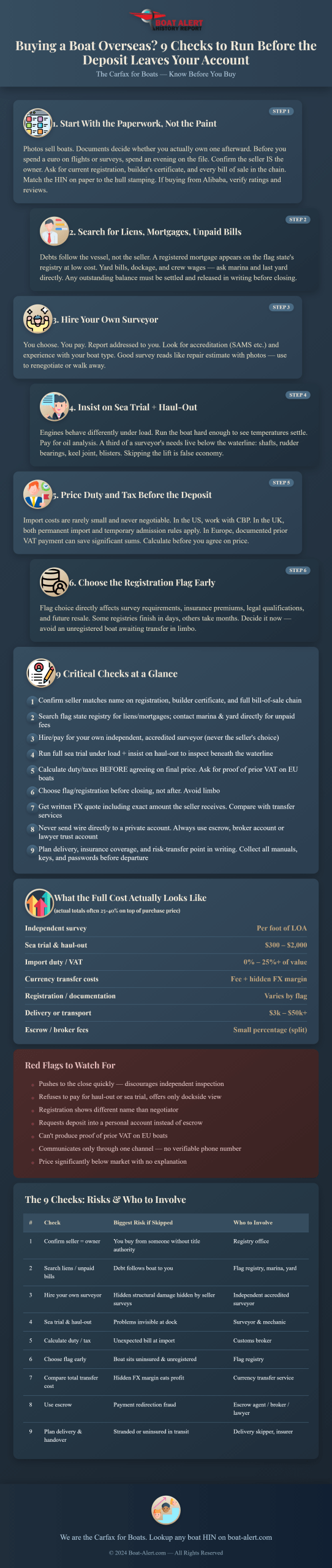
The 9 Checks at a Glance
| # | Check | Biggest Risk If Skipped | Who to Involve |
|---|---|---|---|
| 1 | Confirm the seller is the owner | You buy from someone who can’t legally transfer title | Registry office |
| 2 | Search for liens and unpaid bills | The debt follows the boat to you | Flag registry, marina, yard |
| 3 | Hire your own surveyor | Hidden structural or mechanical damage | Independent accredited surveyor |
| 4 | Sea trial and haul-out | Engine or hull problems invisible at the dock | Surveyor, mechanic |
| 5 | Price duty and tax upfront | A large, unexpected bill at import | Customs broker |
| 6 | Decide on registration/flag | Boat sits uninsured and unregistered | Flag registry |
| 7 | Compare total transfer cost, not just fee | Hidden FX margin erodes the deal | Currency transfer service |
| 8 | Use escrow for the deposit | Payment redirection fraud | Escrow agent, broker, or lawyer |
| 9 | Plan delivery, insurance, handover | Boat stranded or uninsured in transit | Delivery skipper, insurer |
Red Flags to Watch For
A seller’s behavior often tells you more than the listing does:
- Pushes to close quickly or discourages independent inspection
- Resists a haul-out or sea trial, or offers only a dockside look
- Registration paperwork shows a different name than the person negotiating
- Asks for the deposit to go to a personal account instead of escrow
- Can’t produce proof of prior VAT payment on an EU-flagged boat
- Communicates through only one channel and has no verifiable phone number
- Price sits well below comparable listings with no explanation
- Grows evasive when asked about liens, past damage, or insurance claims
What the Full Cost Really Looks Like
The purchase price is rarely the full number. By the time a boat is titled, imported, and floating at your home port, the extras below are often 25–40% on top of the sale price — sometimes more, depending on distance and destination. Treat these as rough planning ranges, not quotes; get real figures from a customs broker, surveyor, and transport company before you commit.
| Cost Category | Rough Range | Depends On |
|---|---|---|
| Independent survey | Charged per foot of length | Boat size, surveyor, location |
| Sea trial & haul-out | A few hundred to a couple thousand | Yard rates, boat size |
| Import duty / VAT | Zero to a meaningful share of value | Destination country, boat origin |
| Currency transfer costs | A small percentage of the amount sent | Provider, amount, route |
| Registration / documentation | Modest to several hundred | Flag chosen |
| Delivery or transport | A few thousand to tens of thousands | Distance, method (sail, truck, ship) |
| Insurance (transit + ongoing) | Varies | Route, crew, ocean-crossing riders |
| Escrow / broker fees | A small percentage, often split | Whether a broker is used |
Documents to Request From the Seller
- Current registration or documentation certificate
- Original builder’s certificate, if the boat is relatively new
- Complete bill-of-sale chain covering every past owner
- Any prior survey reports
- Engine and generator hour logs and service history
- Proof of VAT payment, for EU-flagged boats
- Any warranty documentation still in effect
- Insurance claims history
- Marina and yard invoices confirming no outstanding balance
FAQ
Do I need a lawyer based in the seller’s country? Not always, but it’s worth it for anything beyond a modest, straightforward purchase. A local lawyer can verify the registry search, confirm the escrow terms are enforceable under local law, and catch wording in the sale agreement that a foreign buyer would easily miss.
Can I get financing for a boat I’m buying overseas? Some marine lenders will finance foreign-flagged or foreign-located boats, but terms are usually tighter and the list of approved lenders is shorter than for a domestic purchase. Loan approval is also often contingent on the same survey and title checks covered in the main article, so start that process early.
What happens if the survey finds problems after I’ve already paid a deposit? This is exactly why the sale agreement should specify the deposit is refundable if the survey turns up material issues, and why the deposit should sit in escrow rather than the seller’s account. A clean release condition in writing protects you either way — to renegotiate the price or walk away with your money intact.
How long does the whole process usually take, start to finish? Simple deals with clean paperwork can close in a few weeks. Anything involving liens to clear, an unfamiliar registry, or a flag change can stretch to a couple of months. Building in slack is safer than assuming the fastest-case timeline.
Do I need to be physically present for the survey and sea trial? It’s strongly preferable but not always required. If you can’t attend, use a surveyor you’ve vetted independently, request a live video call during the haul-out, and ask for a detailed photo and video record — never rely solely on a summary from the seller or their agent.
What’s the difference between permanent import and temporary admission? Permanent import means paying full duty and tax and the boat becomes a resident vessel in your country. Temporary admission lets a foreign-flagged boat stay for a limited period without paying duty, usually intended for visiting cruisers rather than a boat you plan to keep long-term. Using temporary admission as a way to dodge duty on a boat you intend to keep is generally against the rules and can result in penalties.
Can I skip import duty by keeping the boat registered abroad? Rules vary by country, but most customs authorities look at where the boat is actually kept and used, not just where it’s flagged. Using a foreign flag primarily to avoid duty is a common enforcement target, and getting it wrong can mean back duty plus penalties later.
Is anything like title insurance available for boats? Marine title insurance exists but is far less standardized than in real estate, and availability depends on the boat’s size, value, and flag. Where it isn’t available or practical, the lien search and clean bill-of-sale chain described in the main article are your main protection.
#Buy #boat #international #overseas #abroad
Categories: To learn more about Boat-Alert.com History Reports for used boats and check a boats title problems online visit: www.Boat-Alert.com