How to sell a boat in North Carolina
Selling a Boat in North Carolina: The Complete Guide
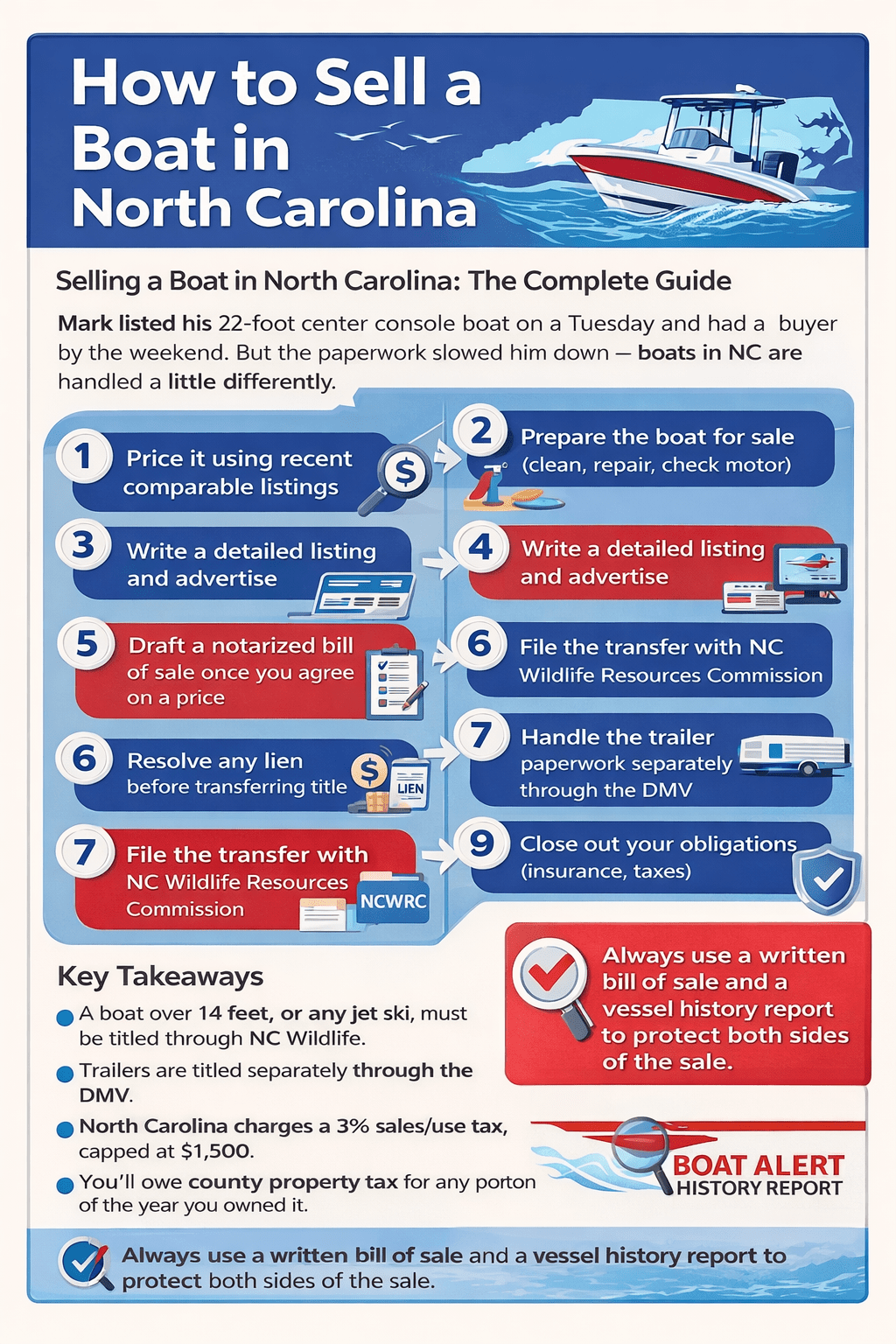
Mark listed his 22-foot center console on a Tuesday and had a buyer by the weekend — the easy part. The paperwork was where things slowed down. He assumed the DMV handled boats the way it handled his truck. It doesn’t. In North Carolina, boats are titled and registered through the Wildlife Resources Commission, not the DMV, and Mark’s trailer — sitting right there on the same driveway — actually does go through the DMV. He also got a call from his county tax office the following January, billing him for a boat he no longer owned, because he’d sold it in July and never updated his personal property listing.
None of this is complicated once you know it. It’s just a different system than selling a car, and most of the confusion comes from assuming the two work the same way. Here’s what actually applies when you sell a boat in North Carolina — the documents, the step-by-step process, and the scenarios that catch first-time sellers off guard.
Key Takeaways
- Boats 14 feet or longer, and all personal watercraft (jet skis) regardless of length, must be titled through the N.C. Wildlife Resources Commission (NCWRC) — not the DMV.
- Every motorized vessel used on NC public waters must be registered, even if it doesn’t require a title.
- A trailer is titled separately through the NC DMV, taxed differently than the boat itself.
- North Carolina charges a 3% sales/use tax on boats, capped at $1,500 — one of the more favorable rates in the country, and worth knowing when you’re pricing and negotiating.
- Boats are subject to annual county personal property tax, billed to whoever owned the boat on January 1 — sell mid-year and you can still get a bill unless you follow up with the county.
- A written bill of sale and a vessel history report protect both sides and help the sale close without surprises.
Do You Need a Title?
North Carolina’s titling threshold is based on both length and boat type:
- 14 feet or longer: Must be titled with the NCWRC before ownership can transfer.
- Under 14 feet: No title required — ownership transfers with a notarized bill of sale or proof of ownership, and the buyer registers the boat using that document.
- Personal watercraft (jet skis): Always require a title, no matter how short they are. This trips people up more than any other rule in the state — a 10-foot jet ski needs a title, but a 13-foot jon boat doesn’t.
- Any boat with a lien: Requires a title regardless of length, since the lien has to be recorded against something.
Titling and registration happen together on the same form — the VL-1, Vessel Registration & Title Application — submitted to the NCWRC (not the DMV). You can apply online, by mail, by phone, or in person at a Wildlife Service Agent.
As with any state, a valid Hull Identification Number (HIN) is required. If yours is missing or illegible, resolve that before you list the boat — it’s the kind of detail that stalls a sale that’s otherwise ready to close.
Documents to Gather Before You List
- Title (boats 14 feet or longer, and all personal watercraft) or proof of ownership for boats under 14 feet
- Current registration card
- HIN, confirmed legible and matching your paperwork
- Lien information, if applicable — lender name, account number, and a payoff quote
- Bill of sale for the actual transaction — HIN, make, model, year, price, date, both parties’ signatures, notarized
- Maintenance and service records
- Manuals and warranty documents for the engine and any electronics
- A recent marine survey, especially for boats above roughly $15,000–$20,000
- Trailer registration, kept separate from the boat’s paperwork
- Vessel history report, optional but reassuring to serious buyers
If your title is lost, apply for a duplicate through the NCWRC as soon as you decide to sell — it’s a straightforward request, but don’t wait until a buyer is ready to close.
Step-by-Step: How to Sell a Boat in North Carolina
1. Price it against real comparables. Check recent sold listings on Boat Trader and YachtWorld for similar make, model, year, and engine hours. Coastal demand (Wilmington, the Outer Banks, the Crystal Coast) often runs differently than inland lake markets, so weight your comparables toward your region.
2. Prepare the boat. Clean, detail, and fix small issues before you list — a stuck bilge pump or a cracked gauge becomes a bigger negotiating point than it should be. For higher-value boats, a pre-listing survey lets you price with confidence.
3. Write an honest, detailed listing. Include engine hours, maintenance history, and recent upgrades. List on Boat Trader, YachtWorld, Facebook Marketplace, and marina bulletin boards; a broker is worth considering for documented vessels or higher-value sales.
4. Handle showings and sea trials safely. Meet at the marina, confirm a serious buyer (a deposit before a sea trial is standard), and go along on the test ride.
5. Put the deal in writing immediately. Draft the bill of sale as soon as you agree on a price, with the HIN, price, date, and both signatures — notarized, since it’s the document that stands in for a title on boats under 14 feet.
6. Resolve any lien before or at closing. If there’s a loan, the payoff typically routes through the lender directly rather than to you personally. Don’t hand over a title with an active, unresolved lien — it will stop the buyer’s transfer at the NCWRC counter.
7. File the transfer with the NCWRC. The buyer needs your signed title (or notarized bill of sale for boats under 14 feet) to title and register the boat in their name. Handling this together at a Wildlife Service Agent avoids paperwork getting lost between you.
8. Handle the trailer separately. If a trailer is included, remember it’s titled through the DMV, not the NCWRC — hand over its registration and, if applicable, its title as its own document, separate from the boat’s paperwork.
9. Close out your own obligations. Cancel or transfer your boat insurance, keep a signed copy of the bill of sale, and — this one’s easy to miss in North Carolina — follow up with the NCWRC and your county tax office to confirm the boat is off your name and your future personal property tax listing.
Real-World Scenarios
You still owe money on the boat
Get a written payoff quote from your lender before listing, and tell buyers upfront that a lien exists — it’s routine and shouldn’t spook a serious buyer. The lien gets recorded on the title (there’s a small fee for this), and the payoff typically happens through the lender directly at closing so the lien can be released and the title transferred cleanly.
You’ve lost the title
Apply for a duplicate through the NCWRC as soon as you’re considering a sale rather than after you’ve found a buyer. It’s a routine request, but a buyer with cash in hand usually won’t wait indefinitely for paperwork to catch up.
You’re selling a boat under 14 feet (not a personal watercraft)
This is the simplest path in North Carolina — no title exists for the boat itself. A notarized bill of sale or statement of proof of ownership is what the buyer uses to register it. Don’t skip the notarization; an unnotarized document can get rejected.
You’re selling a personal watercraft (jet ski)
Even a jet ski well under 14 feet needs a title in North Carolina — this is the one place the length rule doesn’t apply. Sellers sometimes assume a small PWC follows the same under-14-foot exemption as a boat, list it without a title in hand, and then have to backtrack. Confirm you have a valid PWC title before you advertise.
You’re selling a documented vessel
Larger recreational boats are sometimes documented with the U.S. Coast Guard rather than state-titled. Documented vessels don’t receive an NC title — ownership transfers through USCG paperwork instead. They still need to be registered with the NCWRC if kept in North Carolina beyond the visiting period for out-of-state and documented vessels, so don’t assume documentation alone satisfies state requirements if the boat is staying local.
The boat comes with a trailer
Unlike the boat, the trailer is treated as a motor vehicle in North Carolina — it’s titled and registered through the DMV, not the NCWRC, and taxed under the state’s highway use tax rather than the boat’s sales tax. If you’re selling the boat and trailer together, write the trailer into your bill of sale as its own line item with its own VIN, and hand over its DMV paperwork separately from the boat’s title.
Your buyer is from out of state
Common along the coast, where boats change hands across state lines regularly. Make your bill of sale thorough — HIN, price, date — since the buyer will use it to title and register the boat wherever they’re headed next. North Carolina is generally reciprocal with tax already paid in another state, but that’s a detail for the buyer’s home state to sort out; your job is a clean, complete bill of sale and a dated copy for your own records.
You sell the boat partway through the year
This is the scenario that catches the most North Carolina sellers off guard. The state assesses personal property tax on boats annually as of January 1, and there’s no proration if you sell in June or October — whoever owned the boat on January 1 owes that year’s bill, full stop. If you sell mid-year:
- Notify the NCWRC that you no longer own the boat.
- When your county’s personal property listing period opens the following January, report that you sold the boat and give the approximate date, so it comes off your listing going forward.
- Don’t assume registering the transfer with the NCWRC automatically updates your county tax records — it doesn’t. The two systems don’t talk to each other, and the follow-up call to your county tax office is on you.
Taxes and Fees to Know
These generally fall on the buyer, but understanding them helps you set realistic price expectations and answer questions confidently mid-negotiation.
| Item | Approximate Cost |
|---|---|
| Title + 1-year registration (under 26 ft) | ~$70 |
| Title + 1-year registration (26 ft or more) | ~$90 |
| Registration only, no title (under 14 ft) | ~$35 |
| Duplicate title | $35 |
| Recording a lien | $15 |
| Sales/use tax on the boat | 3%, capped at $1,500 |
| Trailer title/registration | Handled separately through the DMV |
Fees are set by the state and can change — confirm current numbers with the NCWRC before finalizing a deal.
Protecting Yourself After the Sale
- Keep a signed, dated bill of sale as your proof of exactly when ownership changed hands.
- Cancel or transfer your insurance once the sale closes.
- Notify the NCWRC that you’ve sold the boat — don’t assume the buyer’s registration paperwork alone closes the loop on your end.
- Follow up with your county tax office during the next listing period so you’re not billed for a boat you no longer own.
Using a Vessel History Report
A report from a service like Boat-Alert.com covers prior ownership, reported accidents, and title or lien history tied to the HIN. It backs up what you’re telling a buyer about the boat’s condition with something independent of your word, and it can support the price you’re asking. Pair it with a mechanical survey for a full picture — the history report tells the story, the survey tells the current condition.
Common Mistakes to Avoid
- Assuming the DMV handles boats. It doesn’t — that’s the NCWRC, and mixing up the two agencies is the most common first step that goes wrong.
- Not realizing a jet ski needs a title regardless of length. This one catches PWC sellers specifically.
- Forgetting the trailer has its own paperwork trail through a different agency.
- Selling mid-year and forgetting the county tax office. You can still get billed the following summer for a boat you don’t own anymore if you don’t report the sale.
- Skipping a written, notarized bill of sale, even on a sale to someone you already know.
Conclusion
Selling a boat in North Carolina comes down to knowing which agency handles which piece — the NCWRC for the boat’s title and registration, the DMV for the trailer, and your county tax office for the annual personal property bill — and closing the loop with each of them once the sale is done. Price it fairly, disclose honestly, get the bill of sale notarized, and follow up on the paperwork after the keys change hands. Handle those pieces and the rest of the sale is mostly just finding the right buyer.
To sell a boat in North Carolina, you must gather your ownership documents, sign over the title or bill of sale, and provide the buyer with the correct paperwork to transfer registration with the NC Wildlife Resources Commission.
1. Prepare Your Boat and Documents
- Clean and repair: Wash the boat, fix minor issues, and gather maintenance records.
- Proof of ownership: Locate your original North Carolina boat title. If the boat is exempt from titling (such as non-motorized vessels, models under 14 feet, or older pre-1987 boats), you will use a transferable registration.
- Bill of sale: Complete a NC Wildlife Bill of Sale Form. Make sure to print and fill out the buyer’s full name and the Hull Identification Number (HIN); never sign over an open title or blank bill of sale. [
2. Handle Boat Trailers (If Applicable)
- Note that boat trailers in North Carolina are registered and titled separately through the North Carolina Department of Motor Vehicles (NCDMV).
- You must provide a separate signed trailer title, and signatures for trailer transfers often require notarization.
3. Complete the Sale
- Sign the title: Fill out the assignment of ownership section on the back of the NC title with the buyer.
- Release of liability: Keep a copy of the bill of sale and a signed record of the transaction date to protect yourself from future liability.
- Payment: Accept secure, verified funds (such as cash or a cashier’s check) before handing over the keys, title, and boat.
4. Buyer’s Registration Step
- The buyer is responsible for submitting the signed title or bill of sale, a completed VL-1 Application Form, and applicable fees to the NC Wildlife Resources Commission online via GoOutdoorsNorthCarolina.com or through a local wildlife service agent.
#NorthCarolina #sell #boat
Categories: To learn more about Boat-Alert.com History Reports for used boats and boat search visit: www.Boat-Alert.com