The Greenest Superyacht Charters: Sailing Without Fossil Fuel
For years, “sustainable superyacht” sounded like a contradiction. A 60-metre motor yacht can burn more fuel in a season than most households use in a lifetime, and the industry knew it. But a quiet shift is underway — and a small group of charter yachts now proves that guests no longer have to choose between scale and conscience.
What “eco” actually means at 50 metres and up
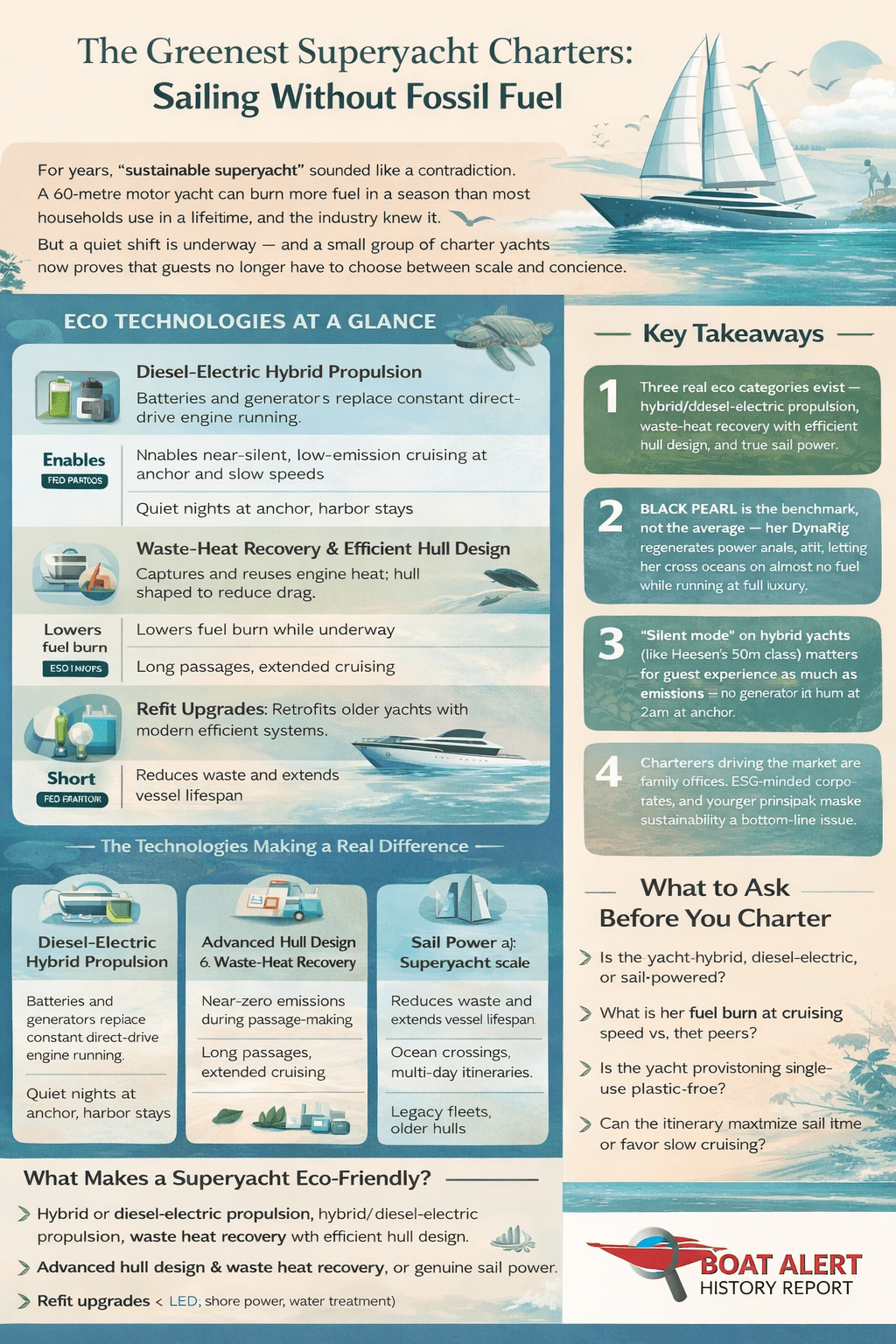
Marketing language in yachting is generous, so it helps to separate genuine engineering from green paint. The technologies that matter fall into three categories: hybrid or diesel-electric propulsion, which allows silent, low-emission cruising at anchor and in sensitive bays; waste-heat recovery and advanced hull forms, which cut consumption underway; and — rarest of all — sail power at superyacht scale, where the wind does the work the engines would.
A yacht offering one of these is making an effort. A yacht combining them is changing the category.
Eco technology at a glance
| Technology | How it works | Emissions impact | Best suited for |
|---|---|---|---|
| Diesel-electric hybrid propulsion | Batteries and generators replace constant direct-drive engine running | Enables near-silent, low-emission cruising at anchor and slow speeds | Quiet nights at anchor, harbor stays |
| Waste-heat recovery & efficient hull design | Captures and reuses engine heat; hull shaped to reduce drag | Lowers fuel burn while underway | Long passages, extended cruising |
| Sail power (e.g., DynaRig) | Wind does the propulsion work; motion can regenerate electrical power | Near-zero emissions during passage-making | Ocean crossings, multi-day itineraries |
| Refit upgrades (LED, shore power, water treatment) | Retrofits older yachts with modern efficient systems | Reduces waste and extends vessel lifespan | Legacy fleets, older hulls |
The benchmark: regeneration under sail
The clearest expression of that change is the 106-metre Oceanco BLACK PEARL, now offered for charter. Her DynaRig — three rotating carbon masts carrying roughly 2,900 square metres of sail — is paired with a hybrid system that regenerates electrical power as she sails, feeding her hotel load from her own momentum. Her Atlantic crossing on almost no fuel remains one of modern yachting’s most quoted statistics, and she has collected environmental awards to match. For charterers, the result is something no conventional superyacht can offer: days of near-silent, near-zero-emission passage-making without sacrificing an inch of luxury.
Key takeaways
- Three real eco categories exist — hybrid/diesel-electric propulsion, waste-heat recovery with efficient hull design, and true sail power. Everything else is closer to green marketing.
- BLACK PEARL is the benchmark, not the average — her DynaRig regenerates power under sail, letting her cross oceans on almost no fuel while running at full luxury.
- “Silent mode” on hybrid yachts (like Heesen’s 50m class) matters for guest experience as much as emissions — no generator hum at 2am at anchor.
- Refitting beats scrapping — LED conversions, shore power, advanced water treatment, and zero-speed stabilisers extend older hulls’ lives sustainably.
- Charterers are the driver, not regulators — family offices, ESG-minded corporates, and younger principals are pushing brokers to answer footprint questions upfront.
- Eco-capable yachts book earlier and command stronger peak-week rates, so sustainability is now a commercial edge, not just a values statement.
Hybrids joining the fleet
Below the sail-powered flagships, hybrid motor yachts are multiplying. Heesen’s hybrid 50-metre class, for example, can run a “silent mode” for near-noiseless nights at anchor — a feature that matters as much for guest experience as for emissions. Meanwhile, refit programmes increasingly add zero-speed stabilisation, LED conversions, advanced water treatment and shore-power capability to older hulls, extending their lives instead of scrapping them — arguably the most sustainable act in yachting.
Spotting real sustainability vs. green paint
Not every yacht claiming an “eco-conscious” refit deserves the label. The tells are usually easy to spot once you know to look: vague language with no numbers (“environmentally considerate design”) instead of published fuel-burn or emissions figures; a single LED lighting upgrade presented as a headline green credential; and no third-party verification behind the claim. Genuine sustainability leaves a paper trail — class societies now offer environmental notations (RINA’s Green Plus and Lloyd’s Register’s environmental class among them), and a growing number of yachts and owners are aligned with independent bodies like the Water Revolution Foundation, which tracks and benchmarks industry impact. If a broker can’t point to a notation, a certification, or a number, treat the claim as marketing until proven otherwise.
Why charterers are driving this
The demand is not coming from regulators; it is coming from guests. Family offices with sustainability mandates, corporations with ESG reporting, and younger principals simply unwilling to holiday against their values are all asking brokers the same question: what is the footprint? Charter fleets are responding because the market rewards it — eco-capable yachts increasingly book earlier and command stronger rates for peak weeks.
What to ask before you book
Charterers who care about impact should press beyond the brochure: Does the yacht have hybrid or silent-mode capability? What is her fuel burn at cruising speed versus her peers? Does the crew run single-use-plastic-free provisioning? Can itineraries favour sail time or slow steaming? A good broker will answer all four without hesitation.
What’s next for the eco fleet
The current generation of hybrid and sail-assisted yachts is a starting point, not an endpoint. Wind-assist technology — rigid sails and rotor systems borrowed from commercial shipping — is beginning to appear on conventional motor yacht designs, not just purpose-built sailing giants like BLACK PEARL. Several yards have hydrogen fuel-cell and methanol-powered concepts in active development, aimed at zero-emission hotel loads even when the main engines are off. Electric tenders and water toys are becoming standard rather than novel, and marinas across the Mediterranean and Caribbean are steadily adding shore-power infrastructure to match. None of this is mainstream yet — but it means today’s most eco-capable charter yachts are a preview of where the whole fleet is heading, not a ceiling.
The takeaway
Sustainable chartering is no longer about compromise — the greenest yachts afloat are also among the most extraordinary. And with icons like BLACK PEARL proving that a 106-metre yacht can cross oceans on wind and stored energy, the rest of the fleet has run out of excuses.
FAQ
What actually makes a superyacht “eco-friendly”?
It comes down to real engineering, not branding — hybrid or diesel-electric propulsion, waste-heat recovery paired with efficient hull design, or genuine sail power. A yacht with one of these is making an effort; one combining several is redefining the category.
Is BLACK PEARL the only sail-powered eco superyacht available to charter?
She’s the clearest example at scale, thanks to her DynaRig and regenerative hybrid system, but she’s not literally the only sail-assisted option on the charter market — she’s simply the benchmark other yachts are measured against.
Do hybrid or eco-capable yachts cost more to charter?
Not necessarily more per se, but they’re increasingly in higher demand. Eco-capable yachts tend to book earlier and can command stronger rates during peak weeks, so availability — more than price — is often the real constraint.
What is “silent mode” and why should charter guests care?
It’s a hybrid propulsion setting that lets the yacht run on battery power alone for a period, cutting generator noise and vibration. Beyond the emissions benefit, it means genuinely quiet nights at anchor — a guest-experience upgrade, not just an environmental one.
Can a charter itinerary itself be made more sustainable?
Yes. Favoring sail time over engine time, slow steaming between destinations, and single-use-plastic-free provisioning are all itinerary-level choices a good broker and crew can build in without compromising the experience.
What should I ask my broker before booking an “eco” yacht?
Four things: Does she have hybrid or silent-mode capability? How does her fuel burn at cruising speed compare to peers? Is provisioning single-use-plastic-free? Can the itinerary be weighted toward sail time or slow steaming? A knowledgeable broker should answer all four without hesitation.
Green superyachts combine ultra-luxury maritime travel with eco-friendly technologies like hydrogen fuel cells, solar panels, and hybrid-electric propulsion to reduce carbon emissions.
Notable Eco-Friendly Superyachts
- Breakthrough (Project 821): Built by Feadship, this 119-meter mega yacht is the world’s first hydrogen-powered vessel of its kind, using hydrogen fuel cells to run hotel operations completely emission-free.
- Zero: Developed by Dutch builder Vitters, this 69-meter sailing yacht operates completely fossil-fuel-free, utilizing 100 square meters of solar panels and underwater turbine propellers.
- Sanlorenzo 50Steel: Features a modular green methanol fuel cell system developed with Seaman’s Energy, allowing the yacht to generate carbon-neutral electricity for all hotel equipment while at anchor.
- Sunreef 43M Eco: A solar-electric luxury catamaran utilizing solar cells embedded directly into the bodywork, masts, and boom alongside an advanced hydro-generation system.
Key Green Technologies Used
- Hydrogen Fuel Cells: Converts hydrogen into clean electrical energy for zero-emission onboard power.
- Solar Integration: Solar skins and panels built into decks and superstructures to capture renewable energy.
- Hydro-generation: Propellers that spin while the vessel is under sail to recharge onboard battery banks.
- Green Methanol: Reformer systems that turn alternative fuels into usable hydrogen energy without major storage hurdles.
#Green #ecofriendly #superyachts
Categories: To learn more about Boat-Alert.com History Reports for used boats and hin number search visit: www.Boat-Alert.com