Taxes on Boats in Florida
Florida Boat Taxes: A Complete Guide for Owners and Buyers
Steering a boat through the Gulf of Mexico is one of the best reasons to live in Florida — but owning a boat here also means understanding the state’s tax rules. This guide walks through what’s taxable, what’s exempt, how registration deadlines work, and what changes depending on your situation, whether you’re a first-time buyer, a longtime owner, or moving to Florida with a boat already in tow.
This article is for general information only and isn’t tax or legal advice. Florida’s boat tax rules have real dollar consequences and some exemptions require precise paperwork and deadlines, so confirm details with the Florida Department of Revenue (floridarevenue.com) or a maritime attorney/CPA before you rely on anything here for a specific transaction.
Key Takeaways
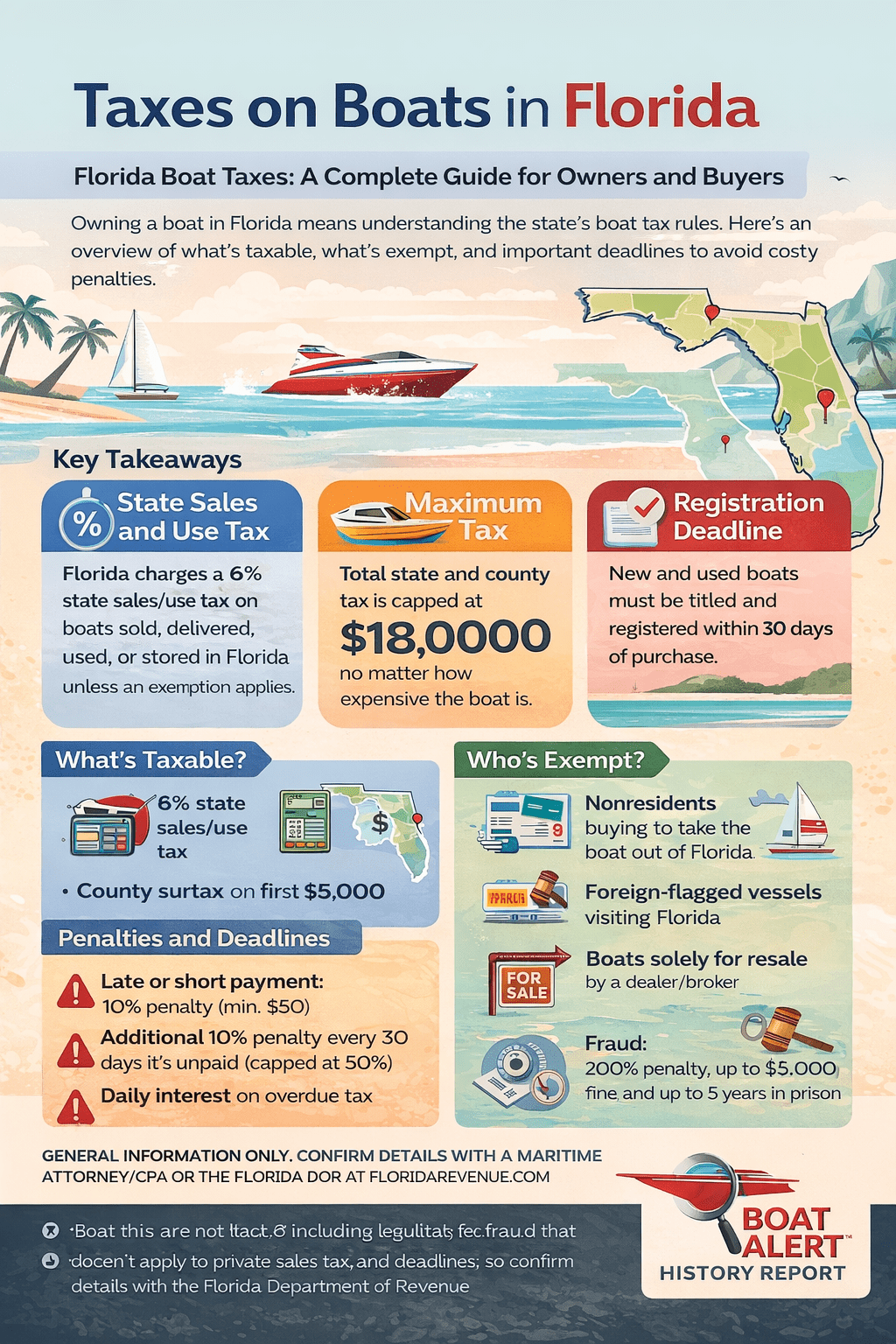
- Florida charges a 6% state sales and use tax on boats sold, delivered, used, or stored in the state, unless an exemption applies.
- Counties may add a discretionary surtax, but for boats it only applies to the first $5,000 of the purchase price — so it adds at most a few hundred dollars, never a percentage of the whole boat.
- Total state and county tax on a single boat is capped at $18,000, no matter how expensive the boat is.
- New and used boats must be titled and registered within 30 days of purchase.
- Registered dealers and brokers can deduct a trade-in’s value before calculating tax.
- Nonresidents, boats brought in only for repair, and boats imported solely for resale may qualify for exemptions — but each has strict paperwork and deadlines.
- Late or underpaid tax carries a 10% penalty (minimum $50), escalating penalties for chronic late payment, and daily interest — plus much harsher penalties for fraud.
What’s Taxable on boats?
State Sales and Use Tax (6%)
Any boat sold, delivered, used, or stored in Florida owes the state’s 6% sales and use tax, calculated on the full purchase price. It doesn’t matter where you originally bought the boat — if it’s used or stored in Florida and it hasn’t already been taxed, the state can collect use tax on it.
Discretionary Sales Surtax
This is the part most owners get wrong. Florida counties can levy their own local “discretionary sales surtax,” and rates vary county by county — but for boats (as with cars, mobile homes, and aircraft), the surtax only applies to the first $5,000 of the purchase price, not the full sale amount. Since county surtax rates typically run somewhere between about 0.5% and 2.5%, the most a county surtax can add to any boat purchase is roughly $125, regardless of whether the boat costs $50,000 or $5 million.
The $18,000 Maximum Tax
Since July 1, 2010, Florida has capped the combined state tax and county surtax on a single boat at $18,000. Because 6% of $300,000 is $18,000, the cap effectively kicks in once a boat’s price crosses that threshold — below $300,000 you pay the standard 6% (plus any surtax on the first $5,000); above it, your tax bill stops climbing. This is one reason Florida attracts large-yacht buyers from across the country. (A separate $60,000 cap applies to sales tax on a single boat repair job in Florida.)
When Tax and Registration Are Due on boats
| Situation | Deadline |
|---|---|
| Boat purchased in Florida | Title and register within 30 days of purchase; keep proof of purchase date aboard the boat during that window |
| Boat already registered in another state, brought into Florida | Can generally be operated on the out-of-state registration for up to 90 days; once Florida becomes the boat’s state of principal use (or the 90 days pass), it needs to be titled and registered in Florida |
Operating an unregistered vessel past the 30-day window is a second-degree misdemeanor in Florida, so this isn’t a deadline worth missing.
Filing and Paying the Tax
Dealers and brokers are required to collect tax from the buyer at the time of sale or delivery. The Florida Department of Revenue offers electronic registration, filing, and payment for sales and use tax, and most filers submit returns monthly, quarterly, or annually depending on the volume of tax they collect. Returns and payments are due on the 1st of the month following the reporting period and are considered late after the 20th.
Trade-In Allowance
If you buy your next boat through a registered Florida dealer or broker, you can deduct the value of a trade-in (or other personal property, not real estate) from the purchase price in the same transaction — tax is then calculated only on the net price. This deduction is only available through registered dealers and brokers; it doesn’t apply to private, boat-to-boat swaps between individuals.
Credit for Tax Paid Elsewhere
If you already paid a legitimate sales or use tax on the boat in another state or country, Florida will generally credit that amount against what you owe here, so you’re not taxed twice on the same purchase. You’ll need documentation proving the tax was paid. If the other jurisdiction’s rate was lower than Florida’s, you typically owe Florida the difference rather than nothing at all.
Exemptions for taxes on boats
Sales to nonresidents through a dealer or broker. A boat sold by a registered Florida dealer or broker to someone who isn’t a Florida resident (and isn’t a business controlled by Florida residents) can be exempt from Florida tax if the buyer removes the boat from the state. There are two common paths: a “safe harbor” decal purchased through the broker that allows the boat to stay in Florida up to 90 days (extendable to a total of 180 days), or a standard nonresident affidavit process with its own removal and proof-of-departure deadlines. The paperwork requirements are specific and strictly enforced, so this is worth coordinating directly with your broker and the Department of Revenue.
Foreign-flagged vessels. Boats flagged outside the U.S. that are only visiting Florida, and aren’t being used to conduct business or earn income while here, generally aren’t subject to Florida sales tax.
Boats imported solely for resale. A boat brought into Florida for the sole purpose of being sold at retail by a registered dealer or broker is exempt from use tax, as long as it stays under the dealer’s or broker’s custody and control and isn’t used personally while in the state.
Boats in Florida only for repair. A boat brought in solely for repairs, modifications, or additions can remain tax-exempt while the work is being done, with a limited window (around 20 days) to leave the state once the repairs are finished.
Penalties and Interest
Florida’s penalty structure is stricter — and different — from what’s commonly assumed:
- Late filing or late payment: a flat 10% penalty on the tax due, with a $50 minimum, even if no tax is ultimately owed.
- Continued nonpayment: an additional 10% penalty for every additional 30 days (or part of a month) the balance remains unpaid, up to a maximum of 50% of the tax due.
- Interest: a floating daily interest rate that the Department of Revenue resets roughly every six months based on market rates (it has recently run in the 11–12% annual range) — check floridarevenue.com for the current rate rather than assuming a fixed figure.
- Fraud: someone who knowingly submits a false nonresident exemption affidavit faces the full tax due, interest, a mandatory 200% penalty, a fine of up to $5,000, and up to 5 years in prison.
Staying current on filings — even filing a zero-dollar return when nothing is owed — avoids the worst of these penalties.
Registration Requirements for Dealers and Brokers
Anyone selling or importing boats at retail in Florida — including dealers who sell new or used boats, and brokers who facilitate sales for others — must register with the Florida Department of Revenue to collect and remit sales tax. This keeps every transaction in the chain properly taxed and traceable.
Which Scenario Are You In?
Buying new from a Florida dealer. The dealer collects the 6% state tax plus any surtax on the first $5,000 at the time of sale, and can apply a trade-in credit if you’re trading in a boat. If the price tops $300,000, ask the dealer to confirm the $18,000 cap is being applied correctly.
Buying used from a private seller in Florida. Private, individual-to-individual sales are fully taxable if the sale or delivery happens in Florida — you’ll pay the tax yourself when you title and register the boat, generally within 30 days. There’s no trade-in deduction on a private sale.
Moving to Florida with a boat you already own. Once Florida becomes where the boat is principally used, you’ll need to title and register it here (your old state’s registration doesn’t carry over, though its title/registration documents serve as proof of ownership). You may owe Florida use tax unless you can show equivalent tax was already paid elsewhere.
Nonresident buying a boat to take out of state. Work with a registered dealer or broker from the start — the nonresident exemption generally isn’t available on private sales, and the removal deadlines and affidavit paperwork are strict enough that missing them can mean paying the tax anyway.
Buying a high-value yacht (over roughly $300,000). Confirm you’re capped at $18,000 in combined state and county tax, and get a clear, itemized calculation from the seller — this is the price range where math errors (like treating the county surtax as a flat percentage of the full price) are most costly.
Bringing in a foreign-flagged vessel to visit. As long as the boat isn’t being used commercially or for hire while in Florida, and it’s genuinely just visiting, it typically isn’t subject to Florida sales tax — but keep documentation of your itinerary and dates in case you need to demonstrate the visit was temporary.
FAQ for boat taxes in Florida
What’s taxable for boats in Florida? Any boat sold, delivered, used, or stored in Florida owes 6% state sales/use tax, plus a county surtax on up to the first $5,000 of the price, unless an exemption applies.
When is boat tax and registration due? Boats purchased in Florida must be titled and registered within 30 days. Boats already registered elsewhere generally have up to 90 days of use in Florida before Florida registration is required.
Can I deduct a trade-in when buying a boat in Florida? Yes, but only through a registered dealer or broker — tax is calculated on the price after the trade-in credit.
Can I get credit for tax already paid in another state? Yes, with documentation, Florida will credit tax legitimately paid elsewhere against what’s owed here, though you may owe the difference if the other state’s rate was lower.
Is there really an $18,000 tax cap? Yes — combined state tax and county surtax on a single boat purchase cannot exceed $18,000, effective for purchases since July 1, 2010.
Are there exemptions for boat sales in Florida? Yes: qualifying nonresident purchases through a dealer or broker, foreign-flagged vessels visiting temporarily, boats imported solely for resale by a dealer/broker, and boats present only for repair, each with their own conditions and deadlines.
What happens if I pay Florida boat tax late? A 10% penalty (minimum $50) applies immediately, with an additional 10% for every 30 days it stays unpaid (capped at 50%), plus daily interest at a floating rate set by the state.
Who has to register with the state to collect boat tax? Any boat dealer or broker selling or importing boats for retail sale in Florida must register with the Florida Department of Revenue.
#Boat #Taxes #Florida
Categories: To learn more about Boat-Alert.com History Reports for used boats and boat identification number visit: www.Boat-Alert.com