How to Compare Yacht Listings Before You Buy: 12 Specifications That Matter Most
Quick Answer:
Most yacht buyers don’t lose deals because they chose the wrong yacht—they lose them because they compared the wrong things.
Online listings often look easy to compare: photos, price, length, and a short description. But these details alone don’t tell you how a yacht actually performs, what it costs to run, or whether it fits your real usage.
In this guide, you’ll learn how to compare yacht listings using 12 standardized specifications so you can:
- Avoid judging yachts only by price or photos
- Understand what really affects performance and ownership cost
- Compare different listings on a fair, structured basis
- Identify missing or misleading listing information early
- Shortlist yachts before contacting brokers or sellers
This is especially important when browsing new yachts for sale, as specifications, optional features, and manufacturer packages can significantly affect a yacht’s value.
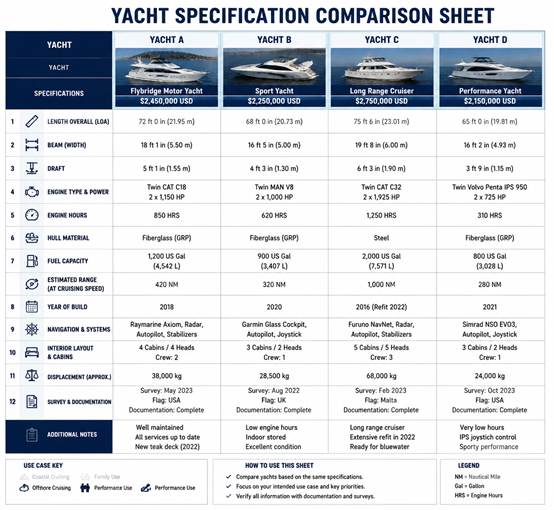
Why You Should Never Compare Yachts by Price Alone
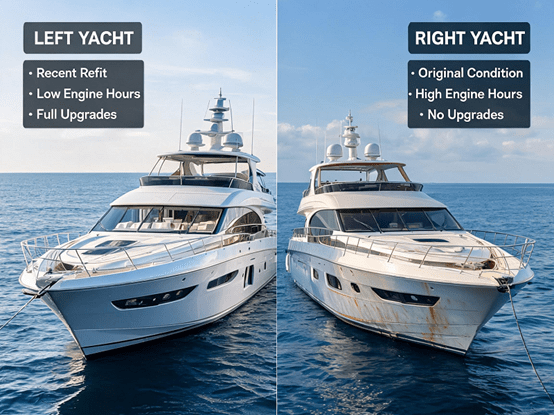
One of the most common mistakes first-time buyers make is sorting listings by price and assuming that higher cost equals better value.
In reality, yacht pricing is influenced by many non-visible factors:
- Engine hours and maintenance condition
- Optional equipment and upgrades
- Regional pricing differences
- Refits or partial refurbishments
- Brand positioning and resale expectations
Two yachts with similar prices can differ dramatically in operating cost, seaworthiness, and long-term depreciation. That is why standardized comparison across specifications is essential.
12 Key Specifications That Matter Most When Comparing Yacht Listings
1. Length Overall (LOA)
LOA defines the total size of the yacht, but it does not always reflect usable space. Some designs maximize interior volume, while others prioritize exterior deck areas.
Always compare LOA alongside layout efficiency, not in isolation.
2. Beam (Width of the Yacht)
Beam strongly influences stability, interior comfort, and cabin size. A wider yacht typically offers:
- More interior volume
- Greater stability at rest
- Larger social areas
However, increased beam can reduce marina accessibility in certain regions.
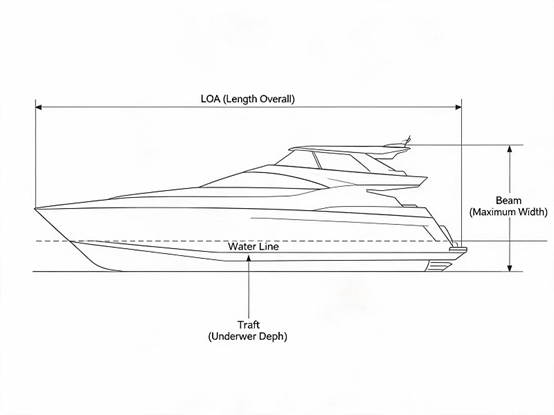
3. Draft (Depth Below Waterline)
Draft determines where the yacht can safely navigate.
Shallow draft: better for coastal cruising and island hopping
Deep draft: improved stability and offshore performance
If listings do not clearly state draft, it is a major information gap.
4. Engine Type, Power, and Hours
Engine specifications are one of the most critical comparison points.
Check:
- Engine brand and model
- Total horsepower
- Engine hours (for used yachts)
- Service history
High engine hours are not necessarily negative, but they must align with maintenance records and usage type.
5. Hull Material and Construction
Common materials include fiberglass, aluminum, and steel.
Fiberglass: common in recreational yachts, lower maintenance
Aluminum: lighter, faster, often used in performance yachts
Steel: strong and suitable for long-range cruising
Construction quality often matters more than material alone.
6. Fuel Capacity and Estimated Range
Fuel capacity directly affects autonomy and cruising range. However, listings rarely include standardized consumption data.
To compare fairly, evaluate:
- Fuel tank size
- Cruise speed efficiency
- Engine load at cruising range
This is especially important when comparing new yachts for sale, where performance claims can vary widely between manufacturers.
7. Condition and Maintenance History
For used yachts, condition is a primary value driver.
Look for:
- Recent refit records
- Regular servicing documentation
- Cosmetic vs structural upgrades
- Signs of corrosion or wear
- Listings without maintenance details should be treated cautiously.
8. Year of Build and Usage Profile
The build year alone is not enough. You must also understand usage history:
- Private use vs charter use
- Freshwater vs saltwater operation
- Seasonal vs full-time usage
A well-maintained older yacht can outperform a poorly maintained newer one.
9. Navigation and Onboard Systems
Modern yachts vary significantly in onboard electronics.
Key systems to compare:
- Navigation and radar systems
- Autopilot and joystick controls
- Stabilization systems
- Communication and entertainment systems
- Missing system details may indicate outdated equipment or incomplete listings.
10. Interior Layout and Cabin Configuration
Interior layout determines usability more than size alone.
Compare:
- Number of cabins and bathrooms
- Crew quarters vs owner-focused layouts
- Open-plan vs compartmentalized design
- Storage capacity
This is where lifestyle alignment becomes critical.
11. Displacement and Weight
Displacement affects:
- Stability in rough water
- Fuel efficiency
- Handling responsiveness
Heavier yachts often provide smoother rides but lower speed efficiency.
12. Survey Status and Documentation
One of the most overlooked but essential factors.
Always confirm:
- Recent marine survey availability
- Registration and title clarity
- Flag state compliance
- Insurance eligibility
Missing documentation is a serious warning signal.
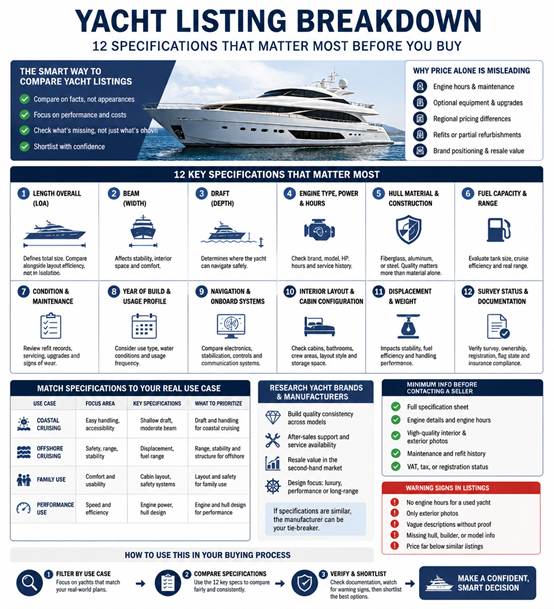
How to Match Yacht Specifications to Your Real Use Case
Before comparing individual listings, group yachts by intended use. This makes it easier to focus on relevant specifications instead of being influenced by price or appearance.
| Use-Case | Focus Area | Key Specifications |
| Coastal Cruising | Easy handling, access | Shallow draft, moderate beam |
| Offshore Cruising | Safety, range, stability | Displacement, fuel range |
| Family Use | Comfort and usability | Cabin layout, safety systems |
| Performance Use | Speed and efficiency | Engine power, hull design |
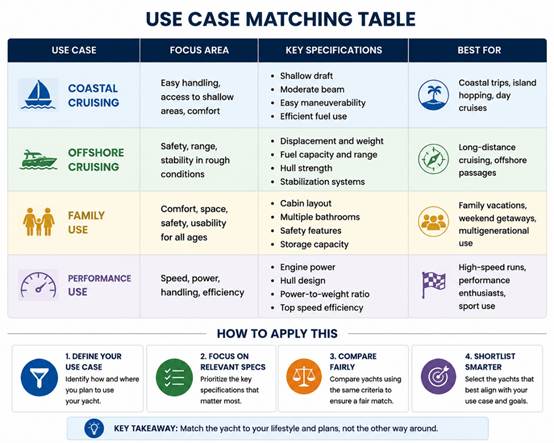
How to Apply This
Use this table as a filter before you start comparing listings in detail:
- Focus on range, stability, and structure for offshore plans
- Prioritize layout and safety for family use
- Focus on draft and handling for coastal cruising
- Focus on engine and hull design for performance-oriented yachts
How to Research Yacht Brands and Manufacturers
After narrowing your shortlist using specifications, the next step is to look at the builder behind each yacht.
Yacht brands and manufacturers influence long-term reliability, resale value, and overall ownership experience, even when two yachts look similar on paper.
Different builders prioritize different outcomes—some focus on luxury interiors, while others emphasize engineering strength or offshore performance.
What to Check
- Build quality consistency across models
- After-sales support and service availability
- Resale value in the second-hand market
- General design focus (luxury, performance, or long-range cruising)
How to Use This Step
If two yachts have similar specifications, the manufacturer can be a useful tie-breaker when making your final shortlist.
What to Confirm Before Contacting a Seller
Before reaching out, make sure the listing provides enough verified information to support a serious comparison. This helps you avoid spending time on incomplete or misleading listings.
Minimum Information to Look For:
- Full specification sheet
- Engine details and engine hours
- High-quality interior and exterior photos
- Maintenance and refit history
- VAT, tax, or registration status
If any of these are missing, treat the listing as incomplete and prepare targeted questions before moving forward.
Warning Signs in Yacht Listings
Some gaps in listings do not automatically mean a bad yacht, but they do require extra verification.
Be cautious if you notice:
- No engine hours provided for a used yacht
- Only exterior photos with no interior images
- Vague descriptions such as “well maintained” without documentation
- Missing hull, builder, or model information
- Price significantly below similar listings without clear explanation
These signals often indicate missing data, not necessarily issues with the yacht itself—but they should always be clarified before proceeding.
How to Use This Step in Your Buying Process
Use this as a final pre-contact filter:
- If key data is complete → proceed to shortlist or contact broker
- If key data is missing → request documentation first
- If multiple warning signs appear → deprioritize until verified
This ensures you only spend time on listings that can be properly compared against your selected specifications.
Final Thoughts
A good yacht comparison is not about choosing the best-looking or lowest-priced listing, but about comparing yachts on the same criteria.
Once specifications, usage, and condition are evaluated consistently, it becomes much easier to identify which yachts are truly worth shortlisting and which ones are not.
FAQ on Yacht listing comparisons and specs
1. What is the most important specification when comparing yachts?
There is no single “most important” factor. Engine condition, hull type, and layout often carry the most long-term impact depending on usage.
2. Why do similar yachts have very different prices?
Differences often come from condition, upgrades, engine hours, brand positioning, and equipment packages—not just size or age.
3. How do I know if a listing is missing critical information?
If engine hours, maintenance records, or hull details are missing, treat the listing as incomplete and request clarification before proceeding.
4. Should I trust online yacht descriptions?
Only partially. Descriptions are marketing-oriented. Always verify with documentation, surveys, or broker confirmation.
5. How important is the yacht manufacturer?
Very important. Yacht brands and manufacturers influence build quality, resale value, service availability, and long-term ownership cost.
6. Is a newer yacht always better?
Not necessarily. Maintenance history and build quality often matter more than age alone.
7. What is the best way to shortlist yachts?
Group listings by intended use, then compare standardized specifications rather than browsing randomly.
#yachts #lifestyle #listings #compare #specifications
Read Related Articles:
- Best Marine Surveyors in Florida Keys
- Best Marine Surveyors in Cleveland
- Delaware Boat Registration
- How Boat Financing Works
- How to Navigate the Legal Process of buying a used Boat
Categories: To learn more about Boat-Alert.com History Reports for used boats and boat hull identification visit: www.Boat-Alert.com