Why a “Clean Title” on a Boat is Meaningless
Why a “Clean Title” on a Boat Is Meaningless
If you’ve ever shopped for a used boat, you’ve probably heard the reassuring phrase:
“Don’t worry, it has a clean title.”
For many buyers, that sounds like a green light—no accidents, no damage, no hidden problems. Unfortunately, when it comes to boats, a “clean title” often means very little and can give buyers a false sense of security.
The Big Misunderstanding About Boat Titles
Most people assume boat titles work like car titles. With vehicles, a title can be branded with labels such as:
- Salvage
- Rebuilt
- Flood damage
- Total loss
If a car has been seriously damaged and written off by an insurer, that history follows the vehicle. Boat titles generally do not work this way.
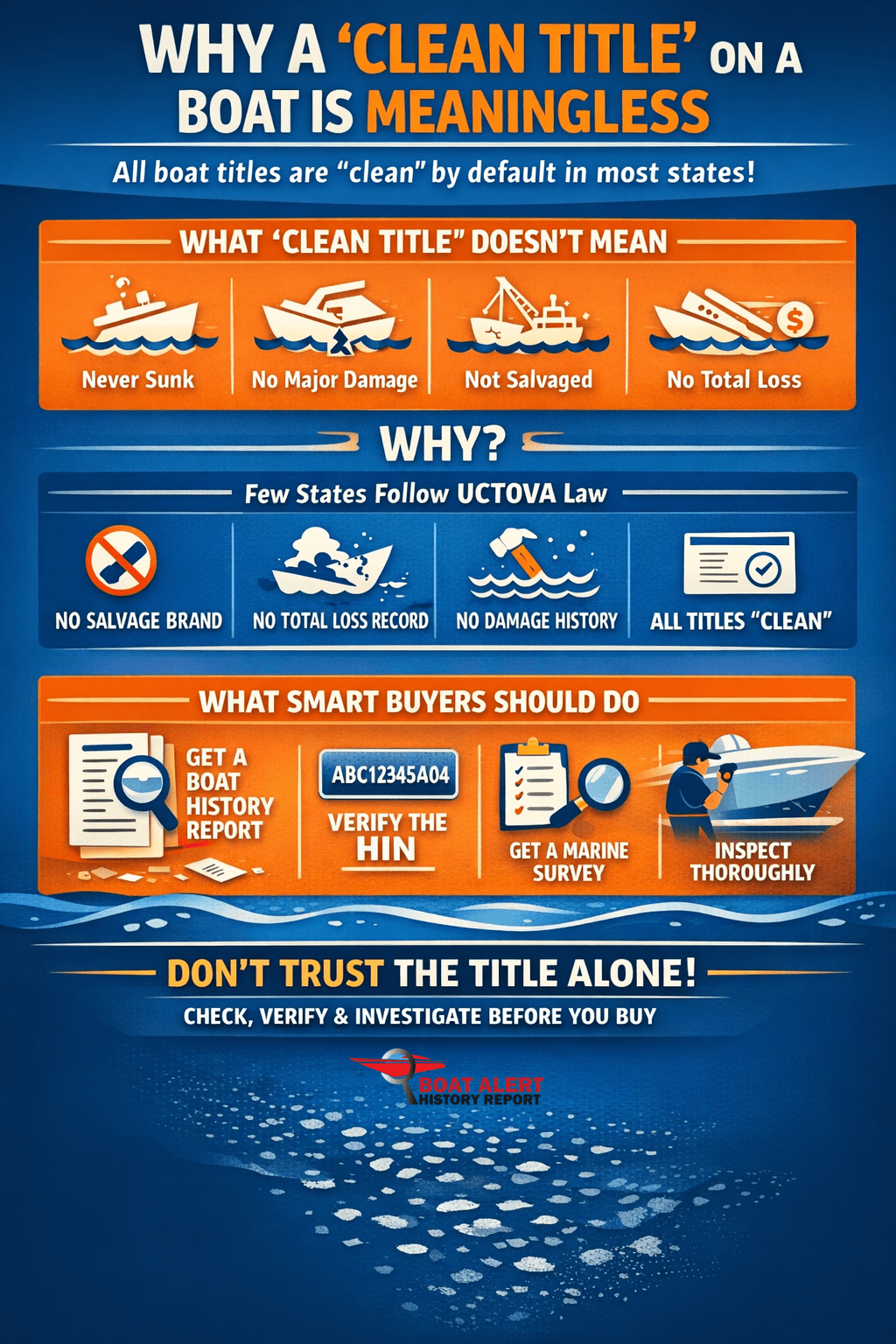
In most U.S. states, a boat title does not record damage history, insurance write-offs, or total losses. As a result, nearly every titled boat is technically “clean”—even if it has been sunk, salvaged, rebuilt, or severely damaged in the past.
UCTOVA: The Law Most States Never Adopted (yet)
There is a law designed to bring more transparency to boat titles: the Uniform Certificate of Title for Vessels Act (UCTOVA).
UCTOVA was created to:
- Standardize vessel titles across states
- Record liens and ownership more clearly
- Reduce fraud and title washing
However, only a small number of states have enacted UCTOVA. The vast majority of states operate under older systems that do not track:
- Salvage status
- Total loss declarations
- Insurance claims
- Major damage events
- Theft
- Liens
In those states, saying a boat has a “clean title” is meaningless—because all boat titles are clean by default.
Why “Clean Title” Can Be Misleading for Boat Buyers
Here’s what a “clean boat title” does NOT guarantee:
- The boat was never in an accident
- The boat was never sunk or flooded
- The boat was never declared a total loss by an insurer
- The boat was never rebuilt after severe damage
- No lien or theft
A boat can be:
- Recovered from the bottom of a marina
- Repaired after hurricane damage
- Written off by an insurance company
…and still carry a perfectly “clean” title.
How Boat Damage History Gets Lost
Boat damage history is often scattered across:
- Insurance claims
- Salvage auctions
- Coast Guard records
- State registration systems
- Marina and repair records
We collect 92 databases here are boat-alert.com so you can search all of them in one place.
Because this information is not consolidated on the title, damage history can disappear when a boat changes hands or crosses state lines. This makes it easy for problematic boats to re-enter the market with no visible red flags.
What Used Boat Buyers Should Do Instead
Rather than relying on a “clean title,” buyers should take a more thorough approach:
1. Run a Boat Alert History Report
A comprehensive boat history report can reveal hidden information that you would have needed weeks of research to obtain. This fills in the gaps that the title alone cannot.
2. Verify the HIN (Hull Identification Number)
The HIN is the boat equivalent of a VIN. Always:
- Verify the HIN on the hull and check it on HINDECODER.COM
- Match it to paperwork
- Check it against national databases on Boat-Alert.com
3. Get a Professional Marine Survey
A survey can uncover the physical aspects of the boat right now so it will complement the history reports by checking:
- Structural repairs
- Water intrusion
- Poor-quality rebuilds
- Hidden damage not visible to the eye
The Bottom Line
A “clean title” on a boat does not mean what most buyers think it means. In most states, it simply means the title exists—not that the boat has a clean history.
Because only a few states adopted UCTOVA, boat titles rarely tell the full story. Smart buyers look beyond the title, verify the HIN, review historical records, and get independent inspections before making a purchase.
When it comes to used boats, trusting the title alone can be an expensive mistake.
Read Related Articles:
- Does a Boat have a VIN Number? (EXPLAINED)
- Find Boat Owner in Florida (9 Ways)
- How to Register a Boat in Prince Edward Island | Vessel Licensing and Registration in Prince Edward Island
- Vessel Documentation Search by Boat Hull Number
- Best Marine Surveyors in Toledo
Categories: To learn more about Boat-Alert.com History Reports for used boats and hin number visit: www.Boat-Alert.com