What to Research Online Before Contacting a Dealer
If you’re searching for a boat, there’s a good chance the marina isn’t where you’ll start your search. That used to be how we got things done, but now, the search usually starts with scrolling through listings online.
You open a few boat marketplaces to see what’s out there, but all you’re really left with are questions. One listing looks perfect, but there’s this other one that also looks pretty good, and the price is low.
Is it too cheap, though? Then there’s that third one that you’re kind of, sort of interested in because of the beautiful photos, but you can’t find enough details on it. Seems like there’s more to figure out than the model and the price.
That early research is super important, no matter how confused you might get.
| Almost 58% of Americans do product research online before purchasing. – Pew Research Center |
Boats can look excellent in photos, but you can’t get to the real story without the details, like past accidents, missing documents, unrealistic prices, or specs that don’t match what the seller claims.
Before you pick up the phone, take a moment and read through a few things smart buyers always check online.
What to Check Before You Reach Out to the Seller
Sellers will do their best to make their boats look great in photos, but you have to get to the real story behind those professional-looking photos. Here’s what you need to find out.
The Boat’s History and Past Owners
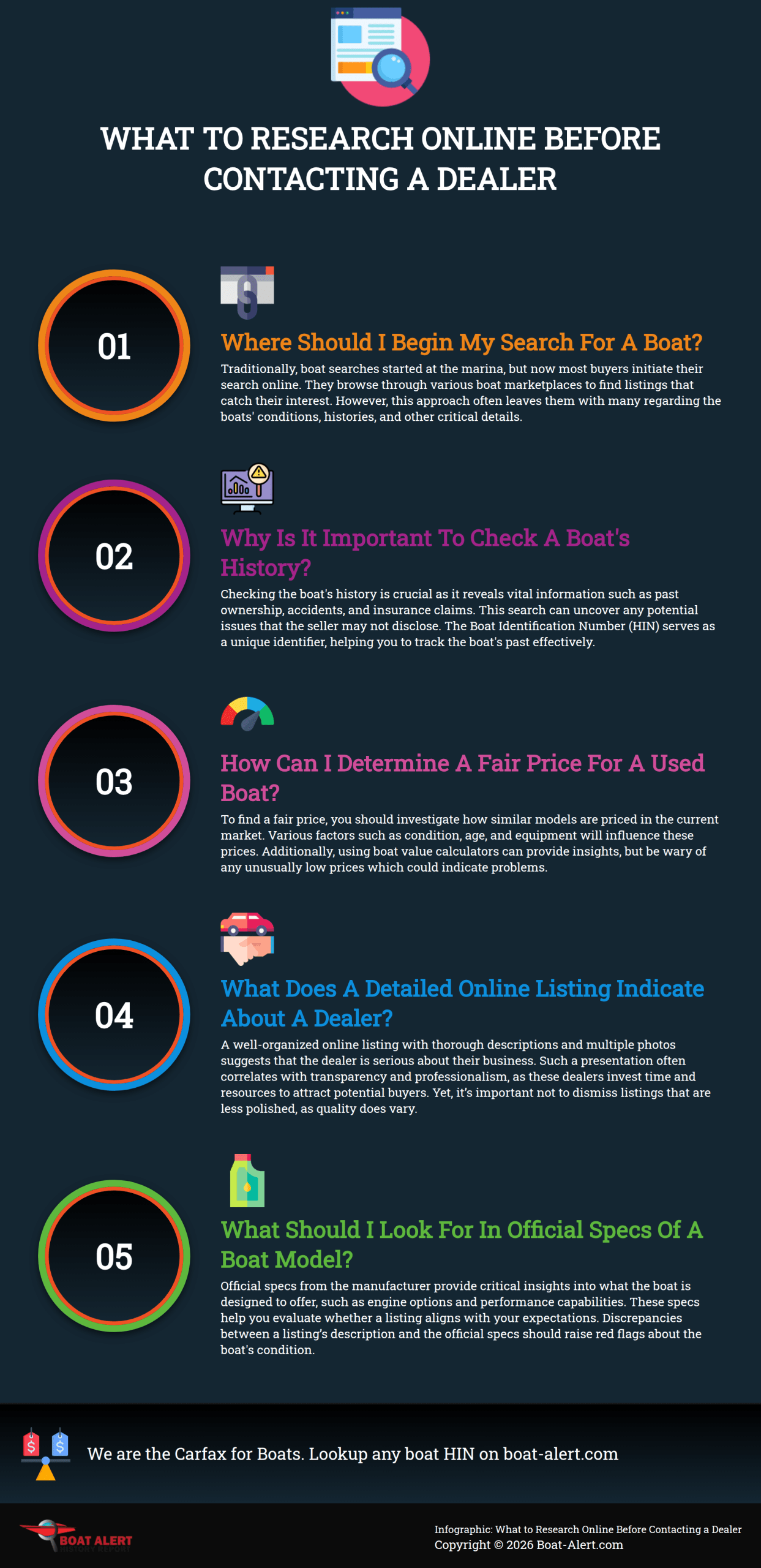
First, check the boat’s history. Who knows who owned it before? It could have changed hands many times, so look into records on ownership, accidents, insurance claims, salvage status, and theft reports. Those few things can already tell you a lot about the boat.
HIN will come in handy here. That’s like a boat’s fingerprint, and you can use it to track information about its past. Run a history check before you go any further; it protects you from potential issues that the seller never mentioned in the listing description. (owner names are not guaranteed due to privacy laws)
What the Same Model Usually Sells For
Once you’ve looked into the boat’s history, it’s time to think about numbers.
Boats rarely have a fixed value, and the price changes depending on condition, equipment, engine hours, and even where the boat is located. So, the best thing you can do now is to look at a few listings for the same model. Compare them, and you’ll probably see a pattern in the price range.
Try the boat value calculators: 10 Best Boat Value Calculators
Don’t immediately fall for the lowest price because an unrealistically cheap boat can mean that something is wrong with it. It might be missing paperwork, or it may be a downright scam.
How the Dealer Presents Their Boats Online
You might think this is a superficial thing to care about, but it’s not.
| 82% of U.S. adults admit to reading online reviews/ratings prior to paying for a product/service. – Rensselaer Polytechnic Institute |
If you see organized listings with clear descriptions, detailed specs, and plenty of photos, then that dealer probably takes the buying process seriously and has nothing to hide.
A lot of top-performing boat dealers will invest in SEO for boat dealers to make their listings stand out among fierce competitors (especially if they’re in locations where there are multiple dealers present).
That doesn’t necessarily mean that listings with less information and fewer photos are bad or suspicious, but if someone made the effort to make their listing look presentable, then they’re probably pretty serious about their business, and they’re looking for any way to collect as many customers as possible.
And just having a nice-looking website and active social media channel isn’t enough – you also have to make sure that the search algorithms recommend your website to searchers.
The Official Specs for That Model
Check the official specs from the manufacturer.
These specs show what the boat originally came with (engine options, size, fuel capacity, performance range). Once you have all that information, you’ll have an easier time evaluating a particular listing. If you see a description and it doesn’t match the factory specs, you’ll want to pay attention to that.
At the same time, specs will help you decide if the boat is actually what you want and if it fits your needs. Some boats are excellent for relaxing and cruising, while others are built for fishing and watersports.
Consider Hindecoder.com to decode that HIN.
Common Problems Reported for that Model
Check what the other owners say about the same model.
You can find out a lot on forums and owner groups; people will often talk about what works and what doesn’t. Some models develop certain issues after a while, and you want to be aware of that. That way, you can ask better questions when you talk to the seller, and it will also prepare you for possible maintenance costs down the road.
Owners are usually really honest about their experiences, and the information they share isn’t something you’ll find in sales descriptions.
Conclusion
Buying a boat should be exciting, and it will be if you don’t leave things up to chance.
Of course, you can never be 100% sure that you’ll be completely happy with what you buy, but you have to admit that doing research can get you a lot closer to that.
So, play detective for a few days, and you’ll know what you’re looking at once you decide to schedule a meeting with the seller.
Read Related Articles:
- Best Marine Surveyors in Sacramento
- Florida Boat Registration: Need to know about Florida Vessel and Watercraft Register
- How to Find The Owner Of A Boat by HIN
- How to Licence a Pleasure Craft in Canada (Must Know in 2026)
- Best Marine Surveyors in Daytona
Categories: To learn more about Boat-Alert.com History Reports for used boats and boat vin visit: www.Boat-Alert.com