Technology and the Sea: Protect Your Data Even on Board
Sailing across open waters has always been about courage, skill, and weather prediction. But in today’s world, navigation charts and compasses are not enough. The modern sea is digital—and with digital systems comes a new storm: cyber threats.
Ships of every size now rely on connected devices, smart communication systems, and satellite internet. Attackers know this, and they don’t stop at the shoreline. Cyber risks travel with you, hiding in the airwaves.
This article explains why cybersecurity matters at sea, what risks exist, and—most importantly—what practical steps you can take to keep your vessel secure.
Why Maritime Cybersecurity Matters
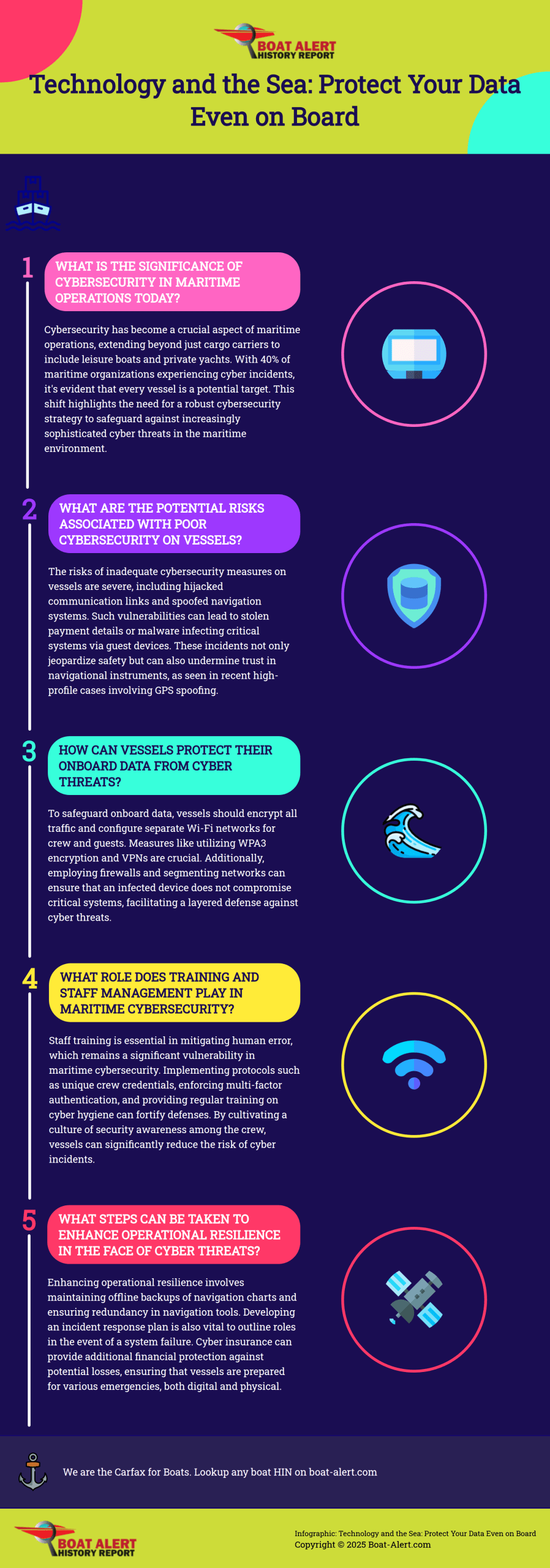
Maritime cybersecurity is no longer just for cargo carriers or cruise liners. Even leisure boats and private yachts have become targets.
- Reality check: According to a 2024 study, 40% of maritime organizations experienced at least one cyber incident last year.
- Weak spots: Vessels often use outdated hardware, legacy systems, and rarely receive timely updates.
- Potential consequences: Hijacked communication links, spoofed navigation systems, stolen payment details, or malware spreading from a guest device into critical ship systems.
Case Example: In 2017, over 20 ships in the Black Sea reported fake GPS signals, causing vessels to “jump” on digital maps. None were sunk, but crews lost trust in their instruments—a reminder of how real the danger is.
5 Practical Ways to Protect Data at Sea
1. Encrypting Onboard Traffic
Every email or financial transaction sent across a ship’s network is like a message in a bottle. Without encryption, anyone can open it.
Checklist for Encryption:
- Use WPA3 for Wi-Fi whenever possible.
- Set up a VPN for crew communications and financial systems.
- Apply encryption especially for satellite internet traffic, which passes through multiple ground stations.
2. Securing Wi-Fi on Boats
A guest uploading vacation photos should not risk the ship’s safety. An open or poorly configured network makes you vulnerable.
Quick Wins:
- Create two Wi-Fi networks: one for crew/operations, one for guests.
- Hide the SSID of the crew network.
- Use long, random passwords (consider a password manager).
- Place a firewall between crew and guest networks.
3. Firewalls and Network Segmentation
Think of firewalls as the watertight bulkheads of your vessel. If one compartment floods, the ship stays afloat.
Practical Segmentation Setup:
- Navigation & safety systems on one network.
- Crew laptops and tablets on a second.
- Passenger/guest devices on a third.
- Entertainment systems isolated completely.
This way, a single infected device cannot spread chaos to critical systems.
4. AIS and GPS Monitoring
AIS and GPS are the backbone of modern navigation, but both can be spoofed.
Protective Steps:
- Use redundant systems: radar + GPS + paper charts.
- Employ AIS anomaly detection tools to catch spoofed signals.
- Train crew to cross-check positions manually if readings look odd.
5. Managing Crew Credentials
Human error remains the biggest vulnerability.
Credential Best Practices:
- No shared logins—each crew member gets their own.
- Remove default usernames/passwords immediately.
- Enforce multi-factor authentication where possible.
- Provide quarterly training on phishing, device hygiene, and access rules.
The Role of Satellite Internet
Satellite internet is a lifeline for weather updates, chart downloads, and keeping passengers connected. But misconfigured or unpatched terminals can be exploited remotely.
To Secure Satellite Connections:
- Apply all firmware and software updates.
- Change default admin credentials.
- Use VPN tunnels for all sensitive communications.
- Regularly audit logs for suspicious activity.
Building Operational Resilience
Cybersecurity at sea is not just about blocking attacks but ensuring safe operations when systems fail.
Resilience Measures:
- Keep offline backups of navigation charts.
- Maintain redundant navigation tools (paper, radar).
- Develop an incident response plan: who does what if systems fail.
- Consider cyber insurance to cover potential losses.
Think of it like preparing for a storm: you can’t stop it, but you can strengthen the ship.
Captain’s Cybersecurity Toolkit (Summary)
✅ Encrypt onboard traffic (WPA3 + VPN)
✅ Separate crew & guest Wi-Fi networks
✅ Use firewalls and segment systems
✅ Monitor AIS & GPS for anomalies
✅ Keep systems updated and patched
✅ Enforce unique crew credentials & MFA
✅ Train crew regularly on cyber hygiene
✅ Keep backups & incident response plans ready
Final Thoughts
Technology has made sailing safer, faster, and more connected. But the sea has added new dangers—digital ones. Firewalls, encryption, crew training, and operational resilience are no longer optional luxuries; they are safety equipment, just like life jackets.
In the digital age, no vessel is truly alone. Hackers can reach you anywhere. Protecting your data is protecting your journey.
Encrypting Traffic on Board
Every message sent across the onboard network is like a bottle thrown into the ocean. Without onboard traffic encryption, anyone with the right tools could open it. Encryption locks those bottles. Strong protocols such as WPA3 or VPN-based channels should always be used to make sure sensitive information—crew data, payment transactions, or even a captain’s emails—cannot be read by outsiders.
This is especially important when using satellite internet security systems. Unlike city-based broadband, satellite connections pass through multiple nodes and ground stations, making interception possible if encryption is weak.
Securing Wi-Fi on Boats
It might sound harmless: a guest connects to the boat’s Wi-Fi to send vacation photos. Yet unsecured Wi-Fi networks on boats open doors to intruders. Hackers don’t need to be close; they just need access. To counter this, owners should establish secure Wi-Fi networks on boats, with hidden SSIDs, strong passwords, and isolated guest connections.
The principle is simple: crew and operational devices belong on one network, guests on another. A firewall in between ensures they never cross.
Firewalls and Network Segmentation
Speaking of firewalls, they serve as the digital walls of the vessel. Without them, everything is exposed to open waters. Combine firewalls with network segmentation, and you create layers. Navigation equipment stays separated from entertainment systems, while personal devices are cut off from critical ship functions.
Imagine the chaos if a crew member’s tablet infected with malware gained access to the autopilot system. Segmentation ensures that such accidents cannot happen.
AIS and GPS Monitoring
The Automatic Identification System (AIS) and GPS devices are vital for navigation. But they are also vulnerable. Spoofed signals can trick vessels into believing they are in safe waters while steering them toward hazards. Continuous AIS and GPS monitoring with verification tools helps detect anomalies. Cross-checking GPS data with multiple systems—like radar—adds resilience.
Small Tech, Big Lessons: The Math Solver App
At first glance, a math solver app seems irrelevant to ships. But think again. Such apps highlight the importance of data handling and secure connections. For example, Download for iOS, so you can better manage data: access rights, passwords, and external servers. If a simple app can leak information when poorly secured, imagine what could happen if navigation systems followed the same careless approach. The lesson? Whether solving equations or steering a yacht, security must travel with the data.
Managing Crew Credentials
Human error remains the weakest link in cybersecurity. Crew credential management is essential. Password sharing? Dangerous. Default logins? Even worse. Each crew member should have individual credentials with role-based access. Multi-factor authentication, even if slower, reduces risks dramatically. Training must also be part of the process: a well-informed crew is as important as any firewall.
The Role of Satellite Internet
Satellite internet is a lifeline for modern vessels. It brings weather updates, charts, communication with shore, and entertainment for passengers. But it is also a target. Attackers can exploit misconfigured terminals. To mitigate this, vessels should apply regular updates, change default device settings, and use encrypted channels. Satellite internet security is not optional—it is a requirement for safe operations.
Building Operational Resilience
Protecting data at sea is not just about reacting to threats but preparing for them. Operational resilience means a vessel can continue safe operations even when parts of its systems are compromised. Backups, redundancy in navigation tools, and incident response plans all contribute to resilience.
Think of it like storm preparation. You cannot control the storm, but you can strengthen the ship.
Conclusion
#CyberSecurity #DataProtection #InfoSecurity #CyberResilience #MaritimeCybersecurity #BoatSecurity #YachtSafety #SecureSailing #MarineTechnology #SatelliteInternet #GPSProtection #AISMonitoring #DigitalSailing
Technology has made sailing safer, faster, and more comfortable. But the sea has not lost its dangers—it has only added new ones. Firewalls, secure Wi-Fi networks on boats, onboard traffic encryption, AIS and GPS monitoring, satellite internet security, and crew credential management form the backbone of maritime cybersecurity.
The oceans remain vast, but in the digital age, no vessel is truly alone. Hackers can reach you anywhere. Protecting data is as essential as keeping life jackets on board. Without security, the journey may not be safe, no matter how calm the waters appear.
Categories: To learn more about Boat-Alert.com History Reports for used boats and boat lien search visit: www.Boat-Alert.com